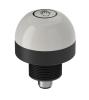
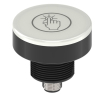
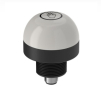
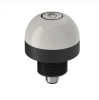
Signalling beacons
The signal light converts the state of the device into information that the operator recognizes without reading the display. When selecting, start with the question of what a person should do after the light comes on or the signal sounds. Another request may have local warnings for material replenishment and other signal lights visible from the access street. The color, light mode, location, and any sound should form a clear whole.
The category includes various constructions and parts of assemblies. It is not possible to deduce common voltage, protection, dimensions or method of control from its name. Panel indication and LED strips are detailed in the guide Signal lamps and LED strips; here the main topic is the choice and integration of beacon into the machine.
Complete beacon, segment or replacement light source?
A complete version includes the manufacturer's specified assembly. A standalone segment represents only its part. In a modular system, distinguish between the base, light levels, light sources, ends and possible acoustic module. EMAS Catalogue The series of IK distinguishes clearly between individual parts and complete assemblies. However, always check the delivery scope according to the specific item.
Before ordering, assemble a parts list: what is already on the machine, what is changing and what will be needed to add. A coloured transparent segment does not necessarily contain an LED source; the mounting tube does not necessarily contain a pin or connection part. Products of the same external diameter may have different locks, contacts or seals. When replacing, therefore, compare the manufacturer, series and full code of the original part.
A separate category is used for replacing the source LED bulbs up to 50mm and 70mm beacons Emas. Continue with the holders and adapters through Beacons accessories. Add space for wiring and for later disassembly, not only the height of the light part.
What signal should the operator recognize?
- Continuous light allows long-term display of the state. Its meaning is determined in the control description of the machine.
- The Flashing alternates between the light being on and off. It may indicate the change, but it must be clear whether it is produced by a beacon or by a control system.
- Flash mode uses short pulses; it is not automatically identical to normal flickering. It is determined by the actual course and supported settings.
- Rotational effect may occur through sequential illumination of LEDs. The designation itself does not confirm the presence of a motor or mechanically rotating optics.
- An acoustic signal draws attention when the operator is not looking towards the equipment. The method of confirmation and silencing must correspond to the process.
Multiple colours in one body are not the same as several separate lighting modules. Determine whether a single selected colour, multiple separated areas, or a combination intended by the electronics is displayed. This is addressed by the category Beacons more colorful and multifunctional EMAS. The number of colours alone does not indicate the number of independent inputs.
Power supply and control should be addressed separately
The power supply rating indicates the electrical energy the product requires. The control interface indicates how you select the colour, lighting mode or sound. Some devices are activated by supplying power, others have additional control wires. The designation 24 V DC does not indicate whether you need a PNP output, NPN output or a no-voltage contact. The AC/DC power supply rating also does not mean any voltage on all terminals.
- Check the rated voltage and allowable range of each connected part. Do not confuse the output voltage of the source with the voltage of the control input.
- According to the diagram, determine the common conductor, polarity and function of individual wires. Do not transfer wire colours between different manufacturers.
- Sum the currents of functions that may be activated simultaneously. Also verify the maximum load of each output and the entire group of PLC outputs.
- Assess the switching current and voltage drop on the wiring. If an isolating unit is required, select it according to the actual load and frequency of switching.
- Verify the behaviour during PLC start-up, power loss and signal overlap. Unintended signal combinations must have a pre-defined solution.
When servicing, first disconnect the power supply and verify the circuit status. A trial operation of an unknown component on a randomly selected voltage does not replace its identification. If the documentation is insufficient, supplement with a diagram or label information before connecting.
Visibility of light and audibility of sound
The size of the light-emitting area is just one part of the selection. Check the operator's view during normal operation, shielding by the housing, backlighting and distance. Optical data in candelas apply to the direction of radiation; lumens describe the total luminous flux. The power consumption alone or the number of LEDs does not prove the readability of a specific status.
When comparing sound, compare the sound pressure level at the same distance and with the same frequency weighting. A dB rating without these conditions is insufficient. Selection belongs to the category Horns. The acoustic rating does not in any way express the visibility of the light part.
A practical takeover may take the form of a short test run: operator stations, material replenishment location and access corridors. At each location, activate individual states and record whether the person correctly recognises them. Repeat the test with closed covers, normal lighting and during real operation of adjacent equipment.
Model example: three states and confirmation of warning
The model workstation should display readiness, material request and operational fault. The designer first creates a table of states and their priorities. When a material request and a fault occur simultaneously, the fault takes precedence; after its removal, the other conditions are re-evaluated. Specific colours and rhythm are determined according to the rules of the machine.
Let's assume three independent light branches of 0.04 A each and an audio branch of 0.10 A. For a permissible current flow of all branches, it is 3 × 0.04 + 0.10 = 0.22 A, which is approximately 5.28 W. This is just a calculation based on hypothetical input values, not the parameters of the supplied light. The switching current, reserve power, and cable load must be considered separately.
If the selected device allows separate control of sound, the operator's confirmation may silence the acoustic branch and leave the display of the cause. The confirmation must not by mistake erase the fault state itself. Verify this procedure also during repetition of the event.
Common questions and errors in selection
Does a green light mean that it is allowed to enter the machine?
The light itself does not indicate a safe state. A common status signal does not automatically represent a safety function and does not replace protective equipment or risk assessment. A LED failure, cable, or control can change the display.
Just pick the same cover as the original beacon?
Check also the mounting conditions, sealing and cable entry. Housing alone does not provide information about resistance to chemicals, long-term sunlight or vibrations. Parameters of one assembly cannot be transferred to all products in the category.
Can I assign a different effect to each warning?
Only within the scope of functions of a specific product and with a clear signalisation concept. Start with a small number of unambiguous states. Before handing over the machine, verify their recognition and store the meanings and wiring in the documentation.