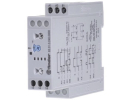
RS1P08H1, EMAS, 8-pin relay socket for DIN rail for relays and compatible counters
RS1P08H1 is an EMAS 8-pin socket for DIN rail mounting 35mm. It serves as a plug-in base for compatible relays and counters, for example the RZ1D1C. series
Rate 24,43 CZK per 1 EUR. Prices are indicative, invoicing is in Czech crowns.
Timing, pulse counting and choosing the mode
RS1P08H1 is an EMAS 8-pin socket for DIN rail mounting 35mm. It serves as a plug-in base for compatible relays and counters, for example the RZ1D1C. series
The EMAS RZ3A1A60S2 electronic time relay has a compact design, an on-delay function and a PNP transistor output. The power supply is 10–30VDC; the delay time is adjustable up to 60s.
The EMAS RZ3A1A30S2 electronic time relay has a compact design, an on-delay function and a PNP transistor output. The power supply is 10–30VDC; the delay time is adjustable up to 30s.
The EMAS RZ1A2C03M-5 analog time relay from the RZ1 series uses on-delay and off-delay. It is intended for a 220VAC power supply and offers an adjustable time of 0.3–3min; the output is 1CO+1NO.
The RELPOL RPC-1MA-UNI multifunction relay provides ten time functions and eight selectable time ranges. It has one changeover contact 16A/250VAC for a resistive load and is mounted on a DIN rail.
The EMAS RZ1A2C12M-5 analog time relay from the RZ1 series uses on-delay and off-delay. It is intended for a 220VAC power supply and offers an adjustable time of 1.2–12min; the output is 1CO+1NO.
EMAS RZ1D1S-5 is a digital time relay with a changeover output 1CO. The variant is intended for a 220VAC power supply and timing from 0.1s to 99h59min.
EMAS RZ1D1S-2 is a digital time relay with a changeover output 1CO. The variant is intended for a 24VAC/DC power supply and timing from 0.1s to 99h59min.
The EMAS RZ1D1C-5 digital counter registers pulses from the input 12–30VDC. The power supply of this version is 220VAC; a separate pulse input is used for reset and one changeover contact is…
EMAS RZ1D1R-2 is a digital time relay with a changeover output 1CO. The variant is intended for a 24VAC/DC power supply and timing from 0.1s to 99h59min.
EMAS RZ1D1R-5 is a digital time relay with a changeover output 1CO. The variant is intended for a 220VAC power supply and timing from 0.1s to 99h59min.
ENDA ECH4400-230VAC can work as a pulse counter or tachometer. The counter supports selection of PNP/NPN and encoder input; the power supply of this variant is 230VAC.
ENDA ECH4400-SM can work as a pulse counter or tachometer. The counter supports selection of PNP/NPN and encoder input; the power supply of this variant is 10–30VDC/8–24VAC.
ENDA ECH7700-SM can work as a pulse counter or tachometer. The counter supports selection of PNP/NPN and encoder input; the power supply of this variant is 10–30VDC/8–24VAC.
ENDA ECH7700-LV is a panel-mounted electronic device for counting pulses and evaluating frequency as a tachometer. For the LV variant, a power supply of 10–30VDC or 8–24VAC. is documented
ENDA ECH7700-230VAC can work as a pulse counter or tachometer. The counter supports selection of PNP/NPN and encoder input; the power supply of this variant is 230VAC.
RZ3A1A30S3 is a compact EMAS analog timer for a Ø22mm hole. The exact variant works with a 10–30VDC, power supply, time 0.1–30s and a PNP/NO transistor output.
EMAS RR3ZTC01 is a multifunction time relay with adjustable timing modes and a range of 0.06s to 30h. The output is one changeover contact for switching control circuits.
CHANA EKT8-M1-12-240VAD is a universal time relay with an adjustable interval from 0.1s to 10 days. The universal power supply 12–240VAC/DC allows use in various control circuits.
RELPOL MT-TUA-17S-11-9240 is a DIN rail time relay with a wide supply range 12–240VAC/DC, changeover contact 1CO/10A and a time setting from 1s to 10 days.
Finder 83.01.0.240.0000 is a multifunction industrial DIN rail time relay with a 24–240VAC/DC, power supply, one changeover contact 16A and a time range of 0.05s to 10h/1d depending on the selected…
ENDA ETM2432-230VAC is a digital panel countdown timer with external start, reset and gate inputs. It has two relays and, for this variant, a 230VAC. power supply
The EMAS RZ1D1C-2 digital counter registers pulses from the input 12–30VDC. The power supply of this version is 24VAC/DC; a separate pulse input is used for reset and one changeover contact is…
ENDA ETM2432-SM is a digital panel countdown timer with external start, reset and gate inputs. It has two relays and, for this variant, a 10–30VDC/8–24VAC. power supply
ENDA ECH4400-SM-RS can work as a pulse counter or tachometer. The counter supports selection of PNP/NPN and encoder input; the power supply of this variant is 10–30VDC/8–24VAC. The RS version…
Prices include the recycling fee.
When designing a simple control, first determine what ends the working step: the elapse of time, reaching a number of events or operator intervention. A fixed delay may suit ventilation, while a batch of pieces needs information about the actual passage of material. Also write down the conditions for interruption and restart. Without them, even a correctly selected time range does not guarantee the required behaviour of the assembly.
For setting with a scale, continue to the category Analog Time Relays. Displaying and entering time are covered by Digital Time Relays. Batching by pulses and frequency evaluation belong to Digital Counters. Decide according to the input information that the process actually provides.
Manufacturer EMAS in the RZ1 series distinguishes analog timers, digital timers and digital counters. The setting method is therefore not an indication of the output type. A digital display alone does not mean a transistor output, and analog setting is not a promise of a 0–10 V signal.
Write three separate pieces of information into the specification: what powers the device, what starts the measurement and what it should control once the condition is met. For timing, define the unit and range; for counting, the meaning of one valid pulse. Then determine whether a further command ignores, restarts or extends the step in progress. Verify this response in the diagram of the specific function, not by the word "multifunction" alone.
For example RELPOL RPC-1MA-UNI has ten time functions and one changeover contact. The number of modes therefore cannot be confused with the number of independently controlled outputs.
Before replacement, compare the full code, the terminal diagram, the mounting version and the space for the cables. For a plug-in device, check the intended socket and its wiring; the same number of pins is not a basis for blind replacement. The wiring record should also include the common conductor of the control inputs, so that service does not have to guess its meaning afterwards.
Choose the output according to the specific load and switching frequency. If the control is to be linked to a motor circuit, also assess Contactors and motor protection. A current specified without the type of load is not enough to decide on the entire assembly.
During acceptance, record the state before the command, during the measurement, after reaching the limit and after a reset. Separately test a power failure and the return of voltage. Retaining the preset, retaining the current value and automatic continuation are different requirements; each needs its own verification. An illuminated output indicator also does not replace checking the actual response of the connected load.
Consider an ideal conveyor with one piece passing every two seconds and a requirement for twelve pieces. From the first to the twelfth passage, eleven intervals elapse, i.e. 22 seconds. If the timing starts one interval earlier, the result is 24 seconds. Stopping the conveyor changes the relationship further. The example shows the need to define the starting event; the numbers are the author's and are not a product parameter.
No. Also record the unit, function, triggering method and response to reset. The same displayed value may represent a different sequence in another configuration.
Only if you explicitly design the application that way. When batching, the output may respond only to the whole batch. The mechanical or electrical life of the contacts is therefore not a promised number of produced pieces or machine working cycles.
We need technical cookies for the cart and checkout to work — these are always used. Analytics cookies show us which pages people look for and where they get lost, and help us improve the shop. We only use them if you allow it. More in the data processing policy.
Choose which cookies we may use. You can change your choice at any time.
They keep the cart contents, your login and selected language, and protect forms from abuse. An order cannot be completed without them, so they are used even without consent.
Google Analytics shows us traffic and behaviour on the website in aggregated form. This tells us which pages are not working for people. We do not identify anyone from this data.