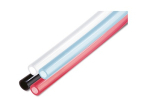
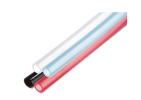
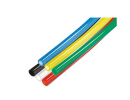
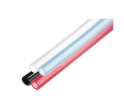
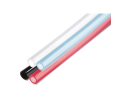
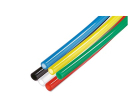
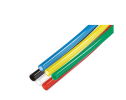
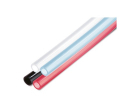
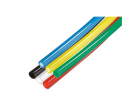
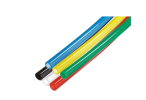
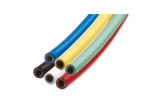
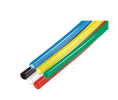
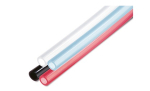
Pneumatic tubes
Choose the tube as part of the whole route between the air source and the point of consumption. The medium, temperature, pressure, length, space and connection method are decisive. When replacing an old line, first copy the designation and measure both diameters. Neither colour nor similar appearance is a sufficient basis for an order.
The listing includes Pneuflex and SMC tubes, straight and coiled versions and cutting tools. The material branches include PU, PTFE and FEP; polyamide is also represented. Selection therefore starts with the operating specification, not the assumption that all items have the same properties.
Material according to the actual task
For a flexible line, assess Polyurethane PU tubes. Pneuflex for ester-based PU emphasises flexibility and abrasion resistance; for polyamide describes options for higher pressures and temperatures than PU. This is a characteristic of these families, not common limit values for all offered sizes.
If the specification includes a chemical medium or elevated temperature, compare Teflon tubes a Fluoropolymer FEP tubes. In the enquiry, state the specific substance, concentration, temperature and contact time. State separately whether the substance flows inside or is used for external cleaning. Only with these data can documentation of the suitability of the whole assembly be requested.
Two diameters, two selection questions
Compare the outer diameter with the requirements of the fitting, the inner diameter with the need for media flow. SMC TU/TIUB table states both dimensions separately and distinguishes metric and inch versions. In addition to the dimension, verify the prescribed material and tolerance; similar numbers in the catalogue do not by themselves prove interchangeability.
For the design, draw the route and mark every fitting, sheet-metal pass-through and change of direction. For each point, decide whether it must remain accessible for service. The drawing allows two routing variants to be compared before purchase and reveals unnecessary loops. For a moving workplace, consider separately Coiled polyurethane PU tubes according to the working reach actually needed.
Model calculation of internal volume
Let us consider, purely for tutorial purposes, two four-metre tubes with an inner diameter of 4 and 6 mm. The volume of the cylindrical space V = π × d² × L / 4 is approximately 50.3 and 113.1 ml. The second variant has 2.25 times larger internal volume. The calculation uses chosen dimensions, not the parameters of a specific product.
The result shows how much space the route itself contains. It does not determine the flow rate, pressure loss or response time. To assess them, add the actual working pressure, consumption and all local resistances. When changing the length, also recalculate the volume; do not compare a new line only by diameter.
Mounting and troubleshooting
According to the SMC mounting instructions disconnect the supply and release the residual pressure. Check for an undamaged square cut, insertion into the specified fitting and routing without tension or twisting. For preparing the ends, use Cutting pliers, knives.
In case of problems, record whether they occur permanently, during consumption, after warming up, or only in a certain position of the machine. Always check one branch at a time and record the changes made. This separates observation from assumption and avoids repeated tube replacement without finding the cause.
FAQ
Is it enough to keep the colour when replacing?
Use colour for your own clear marking. Determine the replacement by the full code, dimensions and documented conditions of use.
Can air consumption be determined from length and diameter?
The dimensions alone determine the geometric volume. Consumption also requires a description of the working cycle and pressure states; the stated model does not calculate it.