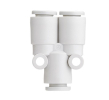
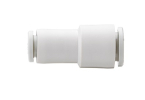
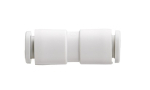
TPGJ10-08, TECHNOLINE, plug-in reducer Ø10mm→Ø8mm
TPGJ10-08, TECHNOLINE, plug-in reducer Ø10mm→Ø8mm. A plug-in adapter into a push-in counterpart with a separate tube connection.
Rate 24,43 CZK per 1 EUR. Prices are indicative, invoicing is in Czech crowns.
Push-in fittings for quick, tight connection of pneumatic tubes without tools – straight, elbow, branch and barb. Choose by tube outside diameter and shape.
TPGJ10-08, TECHNOLINE, plug-in reducer Ø10mm→Ø8mm. A plug-in adapter into a push-in counterpart with a separate tube connection.
TBPU10, TECHNOLINE, straight all-metal fitting for Ø10mm tube. Straight connection of two tubes; suitable for extending a pneumatic route without a thread. Metal body.
TPE16, TECHNOLINE, T-connector for Ø16mm tube. Branching into three pneumatic branches; the flow is divided according to consumption and line resistance.
TPY16, TECHNOLINE, Y-connector for Ø16mm tube. Angled Y-branching for routing three branches with suitable tube geometry.
TBPU12, TECHNOLINE, straight all-metal fitting for Ø12mm tube. Straight connection of two tubes; suitable for extending a pneumatic route without a thread. Metal body.
TBPV08, TECHNOLINE, all-metal elbow fitting 90° for Ø8mm tube. Change of line direction by 90° without a sharp tube bend right at the joint. Metal body.
KQ2U06-00A, SMC, Y-connector, 3× tube Ø6mm. Angled Y-branching for routing three branches with suitable tube geometry.
TPGJ12-10, TECHNOLINE, plug-in reducer Ø12mm→Ø10mm. A plug-in adapter into a push-in counterpart with a separate tube connection.
TBPV10, TECHNOLINE, all-metal elbow fitting 90° for Ø10mm tube. Change of line direction by 90° without a sharp tube bend right at the joint. Metal body.
TBPE08, TECHNOLINE, all-metal T-connector for Ø8mm tube. Branching into three pneumatic branches; the flow is divided according to consumption and line resistance. Metal body.
TBPV12, TECHNOLINE, all-metal elbow fitting 90° for Ø12mm tube. Change of line direction by 90° without a sharp tube bend right at the joint. Metal body.
KQ2U08-00A, SMC, Y-connector, 3× tube Ø8mm. Angled Y-branching for routing three branches with suitable tube geometry.
KQ2U10-00A, SMC, Y-connector, 3× tube Ø10mm. Angled Y-branching for routing three branches with suitable tube geometry.
KQ2U12-00A, SMC, Y-connector, 3× tube Ø12mm. Angled Y-branching for routing three branches with suitable tube geometry.
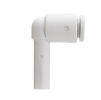
TPLJ04, TECHNOLINE, elbow plug-in adapter, tube Ø4mm. A plug-in adapter into a push-in counterpart with a separate tube connection.
KQ2N04-99, SMC, plug-in connecting stem, 2× stem Ø4mm. A plug-in connecting stem connecting existing push-in fittings, not loose tubes.
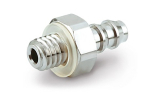
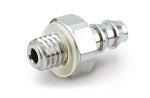
M-3AU-4, SMC, straight fitting with hose barb, thread M3, tube Ø4mm. A hose barb fitting for a soft tube; it is not a standard push-in collet.
M-5AU-4, SMC, straight fitting with hose barb, thread M5, tube Ø4mm. A hose barb fitting for a soft tube; it is not a standard push-in collet.
KQ2H02-04A, SMC, straight fitting, tube Ø2mm, male R1/2. Straight connection of the tube to threaded port R1/2; the thread seal must be verified.
TPLJ08, TECHNOLINE, elbow plug-in adapter, tube Ø8mm. A plug-in adapter into a push-in counterpart with a separate tube connection.
KQ2N06-99, SMC, plug-in connecting stem, 2× stem Ø6mm. A plug-in connecting stem connecting existing push-in fittings, not loose tubes.
KQ2H06-00A, SMC, straight fitting, 2× tube Ø6mm. Straight connection of two tubes; suitable for extending a pneumatic route without a thread.
KQ2H04-00A, SMC, straight fitting, 2× tube Ø4mm. Straight connection of two tubes; suitable for extending a pneumatic route without a thread.
KQ2L08-99A, SMC, elbow fitting 90°, plug-in stem and tube Ø8mm. A plug-in adapter into a push-in counterpart with a separate tube connection.
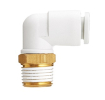
KQ2L02-M5A, SMC, elbow fitting 90°, tube Ø2mm, male M5. Elbow connection of the tube to threaded port M5; changes the line direction at the component.
Prices include the recycling fee.
Select push-in fittings according to what they actually connect: two tubes, a tube with a threaded port, or a tube with the plug-in stem of another part. The range includes Pneuflex and SMC versions in various shapes and sizes. For ordering, therefore, first draw both opposite interfaces. The category name alone does not determine the design of each item.
Section of fitting KQ2 from SMC separates the gripping of the tube by a toothed element from its sealing. The release button engages the gripping. The sealing function and mechanical securing therefore have their own design elements.
The selection record should include the tube outer diameter, the full designation of the counterpart and the required line direction. Record the inner diameter separately for assessing the passage. For the thread, require its system and size; a value in inches without the system is not enough to decide on a replacement. Record separately whether you are selecting a thread for connecting the medium or a thread for fixing into the panel. The similar appearance of these points can hide a different purpose when ordering.
To continue in one axis, open Straight fittings, for changing direction Elbow fittings and for splitting the line Branch fittings. Our own practical rule is to select the functional diagram first and only then the smallest body. For a confined assembly, you also need to draw the access of fingers, tools and the path for pulling out the tube during replacement.
For a replacement part, prepare a simple diagram of the original and intended assembly. Both must show all ends that change during the intervention. If the replacement adds an adapter, also add the new detachable point and its accessibility. This gives you a basis for choosing between a direct replacement and a route change, without deciding solely by the size of the available component.
Before intervention, ensure the safe state of the equipment and verify that no pressure remains in the section being changed. For your own mounting check, compare the actual parts with the drawing, mark the individual branches and check access to all detachable points. Also record the fixing of the line around the fitting. The purpose of the check is to reveal whether future replacement of one tube will require dismantling other components.
Pneuflex for the straight PU family describes inserting the tube and releasing it by pressing the collet. Always relate the exact mounting procedure to the selected version.
Let us consider an explicitly model closed passage with a diameter of 5 mm and an overpressure of 0.7 MPa. A force F = p × A acts on the flat closure. The area A = π × 5² / 4 is approximately 19.6 mm²; since 0.7 MPa corresponds to 0.7 N/mm², the force is about 13.7 N. This is our own illustration of the effect of pressure, not the load capacity of the fitting, the tube pull-out force or the recommended working pressure of the product. The model explains why the state of a connection cannot be assessed by hand alone.
In the service record, separate a problem at the tube inlet, at the threaded counterpart and in the body of the assembly. Record whether the symptom appeared after replacement, during line movement or only during simultaneous consumption. Your own comparison procedure always changes a single circumstance: line layout, verified counterpart or specific connecting part. This way, a selection error can be distinguished from a mounting problem without randomly changing the whole branch.
Check which interface the value belongs to. Record the tube diameter, the plug-in stem diameter and the mounting hole size as different quantities.
Yes, take the specific service operation into account in the design. Assess the free space for inserting, releasing and pulling out the line, not just for the body dimension.
We need technical cookies for the cart and checkout to work — these are always used. Analytics cookies show us which pages people look for and where they get lost, and help us improve the shop. We only use them if you allow it. More in the data processing policy.
Choose which cookies we may use. You can change your choice at any time.
They keep the cart contents, your login and selected language, and protect forms from abuse. An order cannot be completed without them, so they are used even without consent.
Google Analytics shows us traffic and behaviour on the website in aggregated form. This tells us which pages are not working for people. We do not identify anyone from this data.