Electrical consumables
Electrical consumables link the design of electrical equipment with its actual mechanical execution. A well-chosen terminal is no help if the conductor termination does not fit into it; a quality cable in turn needs a suitable wall entry and a well-thought-out route. This category brings together material for terminating, organising, protecting and fixing cabling as well as selected connection and doorbell devices. When selecting, it pays to proceed interface by interface, not just by brand or the nearest size.
Overview of subcategories
Start with the function of the part, not its similar appearance
For stranded conductors connected to suitable terminals, use insulated crimp ferrules; crimp cable lugs are used for a screw connection with a ring. A ferrule and a lug are therefore not two interchangeable variants of the same termination. They differ in contact shape, the space required for connection and the tool used to make the joint. The cross-section figure alone does not determine whether the termination suits a specific terminal.
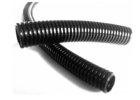
For organising conductors inside a control cabinet, choose trunking and suitable fixing elements. A DIN rail carries devices; it is not a substitute for cable trunking. A conduit protects the route, while its end fitting handles the transition to the equipment. A cable gland works with the cable sheath and the opening in the wall. For moving equipment, routing cables in an energy chain is added. Each of these parts answers a different design question.
Four values that must not be confused
The conductor cross-section in mm² describes the conductive part. The outer diameter of an insulated conductor or of the whole cable in millimetres is a different dimension, needed for example when assessing the entry and the space. The length of the metal sleeve of a ferrule is not the same as the overall length with the insulating collar. The nominal thread of a gland, in turn, does not say how wide a cable its seal will actually accept.
In the working list, therefore record electrical and mechanical data separately. For termination, it is the cross-section, conductor construction and receiving terminal. For the entry, add the outer cable diameter, the thread or mounting hole, the wall thickness and the environment. The need to assess the cable, thread and sealing interface together is explained in the LAPP technical guide to cable glands. The specific ranges, however, must come from the data sheet of the product being ordered.
A fixed route and repeated movement require a different brief
For a fixed installation, draw the route including entries into the control cabinet, slack at the doors and access to devices. For movement, also describe the stroke, the position of the fixed points, the smallest permissible cable radius and the duty cycle. Flexible cable chains choose as part of a moving system, not as a simple substitute for plastic trunking.
The chain length reflects the stroke arrangement and the allowance for the bend. The manufacturer igus distinguishes these relationships in its documentation for calculating energy chain length. The dimensional similarity of another series does not justify adopting its design tables. Already at the design stage, leave space for the end brackets and any chain guidance; the moving bend must not intrude into the operator area or adjacent mechanics.
Mounting interfaces determine the result
For a crimped joint, the conductor, termination and crimping tool belong to a single work procedure. The suitability of this combination and the quality of workmanship are emphasised by Weidmüller in its ferrule documentation. Therefore use the collar colour as an aid to organising work, not as the sole proof of the cross-section. With a twin ferrule, the termination must also be permitted by the receiving terminal.
For a conduit, check its size and profile, compatibility of the fitting and how the route is fixed. For a cable tie, the permissible bundle, material and fixing method are essential. An adhesive base needs a suitable substrate; the mere presence of an adhesive layer is no proof of long-term load capacity in all positions. Each interface has its own conditions and the resulting assembly must meet them all at once.
Worked example: bill of materials for a small assembly
Consider our own production plan for eight identical assemblies. Each has 24 separate stranded conductors and both ends are to be terminated with a single ferrule permitted by the terminals in question. The basic requirement is 8 × 24 × 2 = 384 pieces. Another twelve ferrules are needed for twelve test terminations. In total, the plan therefore counts on 396 pieces, not 192 based on the number of conductors.
If the selected order item contained one hundred pieces, four packs would cover exactly this model requirement. Such a calculation does not, however, merge different cross-sections or lengths into one item: with two types of termination, the quantities are itemised separately. Openings in the enclosure, glands, fixing bases and conduit ends are counted separately in the same way. The reserve is determined by your own production process; it is not a universal percentage.
Ordering and maintenance without unnecessary mix-ups
For small material, a short internal description containing the function, size, series and order unit helps. On receipt, distinguish between a piece, a bag and a whole pack. In the workshop, keep similar terminations separate and attach information on the tool used. When repairing, do not select a replacement only by colour or photo; also compare the size of the contact part and the documentation of the connected equipment.
Socket and doorbell devices belong in this overview as separate functional parts. For sockets and plugs 230V / 400V the complete connection system is assessed; for a transformer, the powered appliance and its consumption. The mains part of the equipment must be designed and carried out by a qualified person. The designation of one part does not transfer the protection rating, current capacity or other properties to an arbitrarily assembled whole.
FAQ
Is a larger accessory size always the safer choice?
No. An oversized termination may fit the conductor or terminal poorly, and an unsuitable sealing range of a gland may not match the cable. The size must suit both sides of the joint.
Can a spare part be identified just by the material designation?
Material is only one piece of information. Add the design series, dimensions, environment, mounting conditions and the function of the original part. For a repair, the complete order code is more useful than a general name.