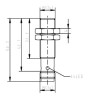
Factor 1 inductive sensors have the same switching distance for steel, stainless steel, aluminium, brass and copper. They are suitable where objects of different metals are detected. Choose by diameter, range and output.
LR12XBF04DPOU LANBAO – inductive sensor with correction factor 1, M12, Sn 4 mm, PNP, NC, connector M12/4 pins. For industrial automation and non-contact metal detection.
LR12XBF04DNOU LANBAO – inductive sensor with correction factor 1, M12, Sn 4 mm, PNP, NC, connector M12/4 pins. For industrial automation and non-contact metal detection.
LR12XBF04DNCU LANBAO – inductive sensor with correction factor 1, M12, Sn 4 mm, PNP, NC, connector M12/4 pins. For industrial automation and non-contact metal detection.
LR12XBF04DPCU LANBAO – inductive sensor with correction factor 1, M12, Sn 4 mm, PNP, NC, connector M12/4 pins. For industrial automation and non-contact metal detection.
LR12XBF04DNOU-E2 LANBAO – inductive sensor with correction factor 1, M12, Sn 4 mm, PNP, NC, connector M12. For industrial automation and non-contact metal detection.
LR12XBF04DNCU-E2 LANBAO – inductive sensor with correction factor 1, M12, Sn 4 mm, PNP, NC, connector M12. For industrial automation and non-contact metal detection.
A Factor 1 inductive sensor is designed for approximately the same switching distance on the metals specified by the manufacturer. It helps when steel, aluminium or other metal parts alternate at one workstation. It reduces differences caused by the material, but does not eliminate the influence of the target's dimensions and position.
LANBAO LR18X-U. Source: LANBAO, manufacturer. Original product image from the manufacturer. Check dimensions and connection according to the order code.
What the correction factor means
The range of a standard inductive sensor may decrease when the material changes. The correction factor expresses the ratio of the range for a given material to the reference target under defined conditions. It is not one universal table valid for all sensor designs.
Illustrative example: if a model has a rated range of 10 mm and the manufacturer specifies a correction factor of 0.4, for a particular metal, the approximate material-adjusted value is 4 mm. For reliable mounting, also take into account the assured switching distance, target size and operating tolerances. The figures are not parameters of the pictured model.
Situation
Benefit of Factor 1
Remaining verification
Same part shape made of different metals
Smaller change in range when the material changes.
Which metals and tolerances the manufacturer actually declares.
Very small component
Material compensation may help.
Size, thickness and effective area of the target.
Oblique or edge-on passage
The influence of the material can be reduced.
Direction of movement, orientation and switching time.
Welding fixture
Alternating materials may be easier.
Resistance to magnetic fields, spatter and heat.
Factor 1 does not mean any metal object
A small screw, thin foil and a wide sheet can create different conditions for the same sensor. An approximately uniform material factor does not guarantee identical switching when the geometry changes. If you change both the alloy and the shape of the part, assess the two influences separately.
The pictured LANBAO LR18X-U series is classified by the manufacturer as Factor 1. For the specific order code, check the range, mounting design and declared behaviour towards individual metals. Any resistance to magnetic interference is a separate parameter that must be compared with the application.
How to design the working gap
First determine the largest gap resulting from the sum of mounting tolerances, play and vibration. It must remain within the verified area of reliable switching for the hardest-to-detect part. At the same time, the smallest gap must prevent a collision. Simply adjusting by the indicator LED while moving the part by hand does not replace this check.
Respect surrounding metal and the specified spacing between sensors. The Factor 1 design does not change the rules for flush and non-flush mounting. Near several sensing heads, check mutual interference according to the manufacturer's installation data.
Comparative test on real parts
Prepare all materials used in their actual thickness, shape and surface finish.
Keep the same bracket, supply and direction of movement; change only the tested part each time.
Record the switch-on and switch-off position over several repetitions.
Verify the largest working gap and the highest machine speed.
Compare the sensor indication with what the PLC actually captures, including the input filter.
The result should be a common usable mounting position for all parts, not just the best distance achieved with one sample.
FAQ
Does Factor 1 designate analogue measurement?
No. It describes the sensor's material behaviour. The output type, for example switching PNP or analogue, must be checked separately.
Will every type of stainless steel switch the same way?
It depends on the declared materials, alloy, dimensions and target conditions. Verify the required behaviour on the real part.
Can I use Factor 1 for welding?
Only if the specific design also meets the requirements for magnetic fields, temperature and spatter. The Factor 1 name alone does not guarantee these resistances.
For a specific selection, prepare the material and dimensions of the target, the working gap, the environmental conditions and the required electrical connection. An overview can be found in the categories Special sensors and Inductive sensors.
Technical documents:LANBAO: LANBAO LR18X-U. This guide helps with selection; binding parameters, wiring and mounting are defined by the documentation of the ordered model.
Cookies on this website
We need technical cookies for the cart and checkout to work — these are always used. Analytics cookies show us which pages people look for and where they get lost, and help us improve the shop. We only use them if you allow it. More in the data processing policy.
Cookie settings
Choose which cookies we may use. You can change your choice at any time.
Technical cookies
Always active
They keep the cart contents, your login and selected language, and protect forms from abuse. An order cannot be completed without them, so they are used even without consent.
Analytics cookies
Google Analytics shows us traffic and behaviour on the website in aggregated form. This tells us which pages are not working for people. We do not identify anyone from this data.