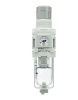
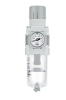
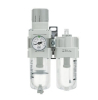
Air preparation units filter–regulator–lubricator
A filter, regulator and lubricator assembly combines air preparation, pressure control and any oil addition. Each function has its own selection criteria. The use of a lubricator must correspond to the consumer; it is not an automatic addition to every modern pneumatic branch.
Selection data Filter regulator with lubricator
| Step |
What to document |
| Identification |
filtration, regulation and oil requirement |
| Operating requirements |
simultaneous consumption of the whole branch |
| Acceptance |
pressure and function of the individual modules |
Design an assembly with lubrication only according to the requirement of the connected equipment. For each consumer, we recommend writing down whether it requires oil supply, what pressure it needs and when it consumes air. These data form the basis for branch distribution and module selection. The mere presence of three functions does not yet address all the requirements of the whole machine.
How to verify the actual composition
The separate SMC manual AC-A shows that AC30A-A connects AW30-A with AL30-A. For the offered AC30A-F03D-A the code D corresponds to an N.O. float drain, which is open without pressure; it does not designate generation D. The last A belongs to the generation designation. The order table also distinguishes the version without a pressure gauge and variants with a gauge.
The range includes TEAC2010-02 and TEAC3010-03 from TECHNOLINE, AC30A-F03D-A and several AW versions. Choose each item according to its own description and full code. For separate lubrication, see the category Lubricators; modules are connected using Connecting accessories. Explicitly mark the presence of the required components in the assembly design.
Principle of a common and separate branch
Filtration, pressure adjustment and oil supply are different functions. Our own design rule is simple: write the requirement of each consumption point into the diagram and check which stages precede it. For two different branches, create two rows of specification. This shows which requirements can be met by the common supply and which must be addressed directly in the specific branch.
The AC-A manual warns that branching and rising lines downstream of the lubricator can disrupt oil transport. The arrangement of the modules is therefore not just a question of space. For AL-D, the manufacturer also states that the numerical scale of the knob expresses the setting position, not the amount of oil delivered. Setting the dose requires checking the actual behaviour under consumption.
Model calculation of simultaneous consumers
The following numbers are our own model, not the flow parameters of the assembly. Let us assume two branches with consumption of 180 and 120 l/min, both relative to the same reference conditions. With simultaneous consumption, the requirement for the common supply is 180 + 120 = 300 l/min. For a preliminary specification, we choose our own reserve of 25 %: 300 × 1.25 = 375 l/min. This reserve is not a manufacturer's recommendation or a guarantee of correct sizing.
If, in the model, only the first branch needs lubrication, we assess its lubricator for the corresponding consumption of 180 l/min, while the common supply is assessed for simultaneity. To verify a specific product, we must add the pressure operating point and the characteristic. The average consumption per shift would not be the same input for this purpose as the instantaneous simultaneity.
Mounting and test operation
For acceptance, we recommend creating your own checklist: full codes, module order, flow direction, access to bowls and available measuring points. Carry out service after depressurising according to the manuals of the parts used. After assembly, verify tightness and function with a repeatable cycle. Record the initial state so that other operators can compare the results.
FAQ
Does the category name confirm the presence of a lubricator?
For ordering, use the documented composition of the specific item. For a combination, verify the list of parts; inclusion in the category alone does not replace this check.
What to check when behaviour changes after extending the machine?
Compare the original and new simultaneity of consumption, the pressures at the same points and the requirements of the added branch. Then verify each changed section of the design separately.
Primary sources: SMC AC-A a SMC AL-D.