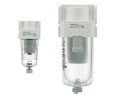
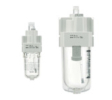
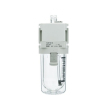
Lubricators for pneumatic circuits
A lubricator adds oil to the air according to the design and operating conditions of the given version. First verify whether the connected equipment requires or permits air lubrication. The suitable oil, setting and location are governed by the documentation of the whole pneumatic branch.
Selection data Lubricators
| Step |
What to document |
| Identification |
lubrication requirement of the consumer |
| Operating requirements |
oil type and flow conditions |
| Acceptance |
dosing function during operation |
Choose a lubricator according to how the oil should reach the lubricated point. In the specification, we recommend stating the equipment's lubricant requirement, the consumption profile and the length of the downstream line. Then decide on a suitable dosing principle. Describe operation with long pauses and short movements separately; the average consumption over the whole shift does not reflect individual working cycles.
Flow and pulse lubricators
The SMC AL-A and AL-D series feed oil into the compressed air. The manuals warn that dripping may not occur at low consumption. For AL30-D with connection 3/8, the table specifies a minimum of 40 l/min (ANR), but at an inlet of 0.5 MPa, ISO VG32, oil, a temperature of 20 °C, a fully open setting and at least five drops per minute.
ALIP1100-01 belongs to a different principle: a pneumatic pulse controls piston dosing of oil. The separate ALIP manual distinguishes the oil supply, control air and oil outlet. To repeat the dose, the control air is exhausted between pulses. The connection design is therefore based on the pulse lubricator diagram, not on the arrangement of a standard flow bowl.
The range includes TEAL1000-M5, TEAL2000-02 and TEAL-3000-03 from TECHNOLINE, as well as AL20-F02-A, AL30-F03-A and AL30-F03-D. When selecting, we recommend keeping a separate row with the full code for each candidate. Do not transfer AL documentation to TEAL based on a similar name alone.
Mounting and initial adjustment
The AL-A manual requires the correct flow direction and the bowl facing vertically downwards. With AL20-A, oil is not refilled under pressure. For this series, the manufacturer prescribes class 1 turbine oil without additives, ISO VG32. Always verify the specific filling method and service for the supplied version.
For your own commissioning, we recommend first preparing a record of the actual working cycle. State the consumption time, the length of the pause and the point where the dose is observed. Repeat the test with the same load and note the initial knob position. This makes it possible to compare individual settings without confusing the effect of adjustment with a change in operating conditions.
Model calculation of oil consumption
The following is our own model of pulse dosing; the numbers are not parameters of ALIP or any other offered lubricator. Let us assume a verified dose of 0.012 ml per pulse and 8 pulses per minute. The consumption per minute is 0.012 × 8 = 0.096 ml. Per hour this is 0.096 × 60 = 5.76 ml, and for six hours of actual dosing 34.56 ml.
If, in the same model, we assume a usable oil quantity of 80 ml, the theoretical time is 80 ÷ 5.76 = 13.89 hours of dosing. This is a balance of specified values, not a service interval of the product. Planning must separately include pauses, the actually usable reserve and the verified dose; the total bowl volume cannot simply be substituted for the usable quantity.
To check dosing, we recommend comparing the number of commands with the strokes actually completed. If only control pulses were recorded, the model would automatically assume successful delivery of each dose. Verify this assumption on the equipment; do not confuse planned consumption with measured oil loss.
Diagnostics without random changes
For AL, SMC lists among the causes of missing drops an incorrect connection direction, low oil level, insufficient flow or a closed setting. We therefore recommend starting your own check record with these observations and only then evaluating a change in dosing.
FAQ
Does the number on the knob mean the number of drops?
The AL-D manual describes the scale as a position guide. The actual dose must be monitored during operation; the scale value alone does not confirm it.
Where to start when designing the whole air preparation unit?
Compare the requirements of the consumers and their simultaneity. For an overview of functions, continue to the category Pneumatic Air Preparation Units.
Primary sources: SMC AL-A, SMC AL-D, SMC ALIP.