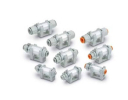
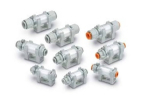
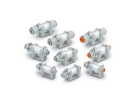
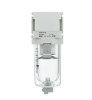
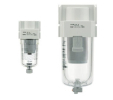
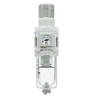
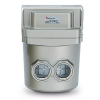
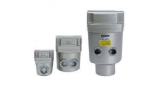
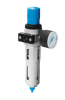
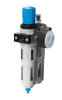
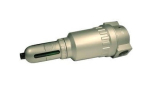
Filter regulators
A filter regulator combines the removal of specified contaminants with control of the outlet pressure. The filtration capacity and flow characteristic are assessed separately. Condensate, pressure drop and maintenance affect the function of the whole branch, not just its static pressure.
Selection data Filter regulators
| Step |
What to document |
| Identification |
filter version and condensate drainage |
| Operating requirements |
flow rate and working pressures |
| Acceptance |
pressure drop and filter condition |
Choose a filter regulator according to two separate requirements: how to prepare the air and what pressure should be available at the outlet. For the specification, we recommend also stating the installation location, usual consumption and the method of condensate drainage. If you write these points down before choosing the size, you will more easily distinguish the properties needed for the process from the mere connection size.
What the combined element actually does
The SMC manual AW-D describes the removal of solid contaminants and liquid water together with pressure regulation. For this series, it specifies a filtration rating of 5 µm. The offered AW20-N02BG-D has an NPT thread according to the order table; the letter F designates a different G thread version. Therefore, do not assess the same fraction in inches without the thread type.
The listing also includes TEAW2000-02-D, TEAW1000-M5 and TEAW-3000-03-D from TECHNOLINE. The range further consists of ZFC, AF, AFD, AMF, AME, SFD, AMH, AF811 and Festo LFR and FRC. For selection, we recommend starting with the full code and verifying the required function in a separate document. The parameters described for AW-D do not automatically apply to all these items.
Condensate, filtration and service
For AF-D, SMC prescribes checking the filter element; clogging can increase the pressure loss and limit the flow. Condensate should be drained before it reaches the element. The manual distinguishes manual drainage from the float auto drain and points out the pressure conditions for its operation. If the drain does not work, the mounting position and the passage of the drain line are also checked.
For AW-D, the manufacturer requires the equipment to be depressurised before dismantling. Regularly check the plastic bowl for damage; the manual allows a neutral cleaning agent for washing it. Leave space in the assembly for removing the bowl and access to the drain. The specific service procedure must correspond to the supplied variant, including the bowl locking method.
Our own procedure for choosing the assembly
First compare the machine requirement with the documented properties of the selected element. Then draw where the measuring points will be accessible. If you are designing a separate filter upstream of regulator, this arrangement allows both stages to be assessed separately. For a combined part, determine in advance which measurements are actually available, so that diagnostics do not promise a value that cannot be read.
Model calculation of the change in pressure loss
This is our own model of a standalone filter, not the parameters of AF or AW. At the same specified flow rate of 360 l/min and the same reference conditions, the pressure upstream of the filter was 0.70 MPa and downstream 0.68 MPa at commissioning. After some time we measure 0.70 and 0.64 MPa. The original loss was 0.02 MPa, now it is 0.06 MPa; the increase is therefore 0.04 MPa.
This model provides a reason for checking, not an automatic instruction to replace. Before drawing a conclusion, we recommend repeating the measurement and verifying the same consumption. With a combined filter regulator, the difference between inlet and outlet also includes the intentional pressure reduction, so it cannot all be attributed to a clogged element.
FAQ
Does a standard filter replace a dryer?
Such a conclusion does not follow from the filtration rating. For excessive humidity, the AF-D manual assumes an upstream dryer or aftercooler. Address the drying requirement separately.
Can flow rates be compared without further data?
For the design, we recommend requiring the same reference conditions and the corresponding pressure point. Without them, it is not clear whether the compared numbers describe the same situation.
Primary sources: SMC AW-D a SMC AF-D.