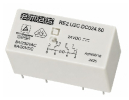
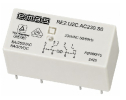
Relay
When looking for a replacement relay, start with the complete order code and its function in the diagram. A similar designation or the same housing does not yet close the selection. Separate the coil requirement from the contact requirement and attach the socket identification. This saves confusion between electrically different versions of one family.
Deciding by code and item content
The category includes RM84, RM87N, R4N, RM699BV, HH54P, the EMAS RE1P11 and RE2 series as well as assemblies PIR6W. For items PIR6W therefore verify the entire content of the assembly, not just the replaceable relay. The existing classification helps find a specific code; it does not by itself say that all items have the same design.
Tables RM84 separate AC and DC coils and contact versions. Determine the parameters according to the complete code, not just the common series name.
Before approving a replacement, store the compared order codes with the same diagram. During the next repair, it will then be traceable according to which requirements the part was selected.
Principle of selecting the contact circuit
Compare the number of contacts with the required functions and for each circuit add the voltage, current and type of load. Besides the highest load, also check the smallest working signal. For small loads, OMRON points out the influence of contact resistance and surface films. A power relay is therefore not automatically a suitable solution for every measuring signal.
For a service store, it is useful to separate parts by their function in the machine. Relays with the same socket may belong to different circuits that require a different version. Add the identification of the approved replacement to the stock label. The cover colour or the same number of terminals are not a sufficient sorting rule.
Author's model example: coil consumption
Let us choose an ideal DC coil with a model power of 0.48 W at 24 V. The steady-state current is I = P/U = 0.020 A, i.e. 20 mA. Four such coils together have a model consumption of 80 mA. This is an author's brief, not the parameters of a specific relay in the range.
The calculation serves as an item in the control power budget. It says nothing about the current of the switched contacts and does not verify the current capabilities of a specific PLC output. For the actual design, add other loads according to their documentation and verify simultaneous operation. Do not use this simple DC model for an AC coil without further consideration.
Mounting and replacement of the inserted relay
The RELPOL PIR6W assembly table states separately the code of the whole assembly, the socket and the working relay. The working relay voltage may not match the input voltage of the assembly. When replacing the insert, base your choice on this assignment, not just on the voltage applied to the base.
Verify connection and mechanical fixing with the corresponding socket; protective and retaining parts can be found in accessories. Store the code of the removed and inserted part in the service record. This prevents a situation where the next repair is based on an undocumented previous replacement.
Diagnosing a recurring fault
For repeated failure, record the switched load, the number of cycles since replacement and the circumstances of the fault. Distinguish whether the relay movement, the contact change or the response of the downstream circuit is missing. Evaluation of measurements and safe securing before handling belong to a specialist. Repeated replacement without describing the cause does not provide documentation for a correct replacement.
FAQ
Is a higher current on the label always better?
It does not address other requirements, such as small signals, type of load, coil or compatibility. Compare the whole brief.
Does the coil data also apply to the contacts?
No. Record the control and contact circuits separately, including the relevant voltages and currents.