Terminals and terminal blocks
A terminal is an interface between conductors, not just a place where copper fits. When designing, you decide at the same time on the electrical connection, mechanical fastening and the possibility of later measurement. A well-assembled terminal block makes it possible to trace a circuit unambiguously, disconnect the serviced device and connect a replacement wire without interfering with neighbouring connections. The starting point should therefore be the circuit diagram and the list of cable cores, not just their total number.
How to find your way around the range
The range includes SUPU and WAGO junction box connectors, miniature and DIN SUPU terminals, screw types as well as ONKA triple-level spring terminals. Separate bridging blocks are represented here by ELEMAN distribution terminal blocks N7, PE7, N12 and PE12.
For small assemblies, open SUPU miniature terminals. The spring-type modular version is divided into the categories up to 1.5 mm², up to 2.5 mm², up to 4 mm² and up to 6 mm². Always check the actual range for the specific conductor type and termination.
A junction box connection solves a local branch or cable joint. A modular arrangement is suitable where you need to follow the link between external cabling and the internal wiring of the control cabinet. A miniature assembly helps with space in a small enclosure, a multi-level one with the density of circuits on the rail. However, assess these benefits together with tool access and the bending radius of the conductors; the smallest footprint may not be the easiest to service.
Contact point, level and potential are not the same
A contact point is the connection point of one conductor. A level describes the spatial arrangement. A potential expresses an electrically common node. Two opposite connections of a feed-through terminal may form one connection, not two independent circuits. Four openings may mean a common branch or two separate paths. Not even the number of coloured actuators decides this question; the actual internal connection must be drawn in the design.
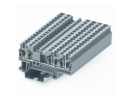
SUPU 303921 is a screw terminal with two levels and four connections. ONKA 1852 is three-level; the manufacturer separately distinguishes the internally bridged version 1862 and the earth version 1872.
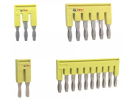
For each group, mark the supply, outputs and the boundaries of the common potential. A jumper is not just a mounting aid: inserting it changes the circuit diagram. A wrong bridge between two supply branches can bypass their separation, connect different voltages or create back-feeding. After changing jumpers, therefore update the documentation and check the wiring before applying voltage.
Conductor and ferrule are chosen together
Distinguish solid, stranded and finely stranded cores, their material and termination. A ferrule changes the outer dimension and stiffness of the end; the same nominal conductor cross-section may therefore not be acceptable with every ferrule. The length of the metal sleeve, the crimping profile and the space for the insulating collar are important. A twin ferrule is also not an automatic permission to connect two conductors into any opening.
A specific example is offered by technical sheet TP1.5-2-GY: stranded conductor without ferrule 0.2–1.5 mm², with ferrule 0.2–1.0 mm². These figures apply to the stated type, not to the entire category.
Before inserting, check that the individual strands are intact and the stripping length. No insulation may remain in the contact area, and at the same time no bare conductor should protrude unnecessarily from the body. Do not shorten fine strands by cutting off some of the wires so that the end fits. If the terminal does not accept the termination, change to a suitably chosen connecting element or an approved termination, not the actual cross-section of the core.
The current is limited by the entire path
The rated current of the terminal alone does not replace the assessment of the conductor, bridge, supply point or protective device. With a branch, the sum of the loads passes through the common section, while individual branches may be less loaded. Take into account simultaneous operation, inrush peaks and heating inside the enclosure. The permitted load of conductors also depends on the installation and ambient temperature, so there is no single current applicable to every circuit of the same cross-section.
Model: common supply of auxiliary circuits
Our own model assumes six DC loads of 0.35 A and four of 0.60 A, all switched on at the same time. The common supply carries 6 × 0.35 + 4 × 0.60 = 4.50 A. At a model voltage of 24 V, the total power is 108 W. This means that the common path must be checked for the entire load, not just for the largest individual branch. The calculation does not include inrush currents, power supply reserve or sizing of protection and does not determine the load capacity of a specific terminal.
Compatibility and protective connection
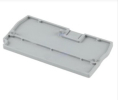
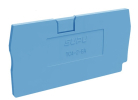
For accessories, check the manufacturer, the specific series, pitch, contact shape and the intended insertion point. The same body width is not proof of bridge compatibility. An end plate closes the prescribed side of the assembly; an end stop prevents it from shifting. These functions cannot be interchanged. For the order, also prepare the labels of individual positions and a space reserve for future changes.
The PE protective function cannot be attributed to a terminal just because of its green-yellow colour. The design and intended use of the specific product, the method of connecting the protective conductor and any connection to the mounting rail are decisive. Plastic fastening on a DIN rail does not by itself create an electrical connection. During assembly, the continuity of the entire designed protective path must be ensured and verified.
What to hand over when the control cabinet is completed
For the finished assembly, prepare a list of terminals, a map of jumpers and the marking of spare positions. When checking without voltage, compare the actual wiring with the diagram, including the points that are to remain separated. A mere continuity check of the intended connections will not reveal every unwanted connection. In the service documentation, also record special terminations and the mounting parts used, so that later replacement does not rely on similarity of appearance.
Frequently asked questions when choosing
Can a spring terminal always be connected without a tool?
Do not confuse the general spring principle with the specific Push-in technology. The way the contact is opened and the conductor inserted depends on the design and on the termination of the conductor. The spring creates the contact force, but does not permit an arbitrary mounting procedure.
Can screw connections be tightened with the same torque?
No. The torque belongs to the specific type and its mounting conditions. To compare designs, open Screw modular terminals 2.5 mm2; during assembly, use the appropriate tool and the manufacturer's value, not tightening by feel.
What does marking both ends of a conductor bring?
It makes it possible to trace a connection even after the cable has been removed from the bundle. The terminal number, core marking and diagram must describe the same link. In a multi-level assembly, add the identification of the level; the sequential number of the body alone may not be unambiguous.