Prices include the recycling fee.
Inductive Sensors
Inductive sensors are used for non-contact detection of metal objects in machines, production lines and industrial automation. In the TECHNOLINE range, you will find cylindrical and rectangular inductive sensors, M8, M12, M18 and M30 versions, PNP and NPN outputs, NO and NC functions, flush and non-flush variants, and sensors with a cable or connector.
When selecting an inductive sensor, compare above all the sensing distance Sn, housing size, flush or non-flush mounting, PNP/NPN, NO/NC, supply voltage and connection type. For special applications, all-metal, analogue, two-wire, high-temperature, high-pressure and Factor 1 inductive sensors are also available.
How to choose an inductive sensor | M8 / M12 / M18 / M30 | Flush / non-flush | PNP / NPN | Cables and connectors | Connecting to a PLC | FAQ
How to choose an inductive sensor
The right inductive sensor must match not only the required sensing distance, but also the material of the detected object, the machine design and the electrical wiring. When selecting, we recommend proceeding in this order:
- Determine the material and size of the target. Inductive sensors are designed primarily for detecting metals.
- Determine the actual operating distance. Do not select a sensor based only on the nominal value Sn.
- Choose the housing size – for example M8, M12, M18, M30 or a rectangular version.
- Decide between a flush and a non-flush version according to the mounting method.
- Choose PNP or NPN according to the input of the PLC or other control system.
- Choose an NO, NC or combined NO+NC output.
- Select a cable or connector and check the number of pins and their wiring.
- Check the protection rating, operating temperature, vibration, oil, water, pressure and other application conditions.
Always confirm the final choice using the current data sheet of the specific model.
How an inductive sensor works
An inductive sensor is a non-contact electronic sensor for detecting metal objects. The active part of the sensor generates a high-frequency electromagnetic field. When a metal object approaches, eddy currents are induced in the material, which affect the sensor's oscillator. The evaluation electronics then change the state of the switching or analogue output.
Because the sensor does not need mechanical contact with the detected object, it is suitable for automation, position monitoring, end positions of mechanisms, counting metal parts, checking the presence of components and other industrial applications.
M8, M12, M18 and M30 inductive sensors
The most common cylindrical versions include inductive sensors with M8, M12, M18 and M30 threads. The size of the sensor affects the mounting options, mechanical robustness and usually also the achievable sensing distance.
- M8 inductive sensors – a compact version suitable for smaller mechanisms and places with limited space.
- M12 inductive sensors – a universal industrial size suitable for a wide range of automation applications.
- M18 inductive sensors – a more robust version, often with a longer sensing distance.
- M30 inductive sensors – larger sensors for applications requiring a longer range and a robust mechanical design.
View LANBAO cylindrical inductive sensors
Flush and non-flush inductive sensors
A flush inductive sensor can, according to its specification, be mounted so that the active part is surrounded by metal. It is suitable, for example, for mounting in metal brackets or machine parts.
A non-flush inductive sensor needs free space around the active part. It often offers a longer sensing distance, but incorrect embedding in metal can significantly affect its function.
| Property |
Flush |
Non-flush |
| Mounting |
Can be embedded according to the manufacturer's specification |
Requires a free zone around the active part |
| Sensing distance |
Usually shorter |
Often longer |
| Typical mistake |
Incorrect geometry of the metal bracket |
Embedding the active head in metal |
Sensing distance of an inductive sensor – Sn, Sr, Su and Sa
The value Sn is the nominal sensing distance. It should not automatically be considered a guaranteed operating distance in every application. The actual function is affected by the material and size of the target, mounting, temperature, manufacturing tolerances and metal objects in the vicinity.
For a reliable design, leave a sufficient margin and verify the operating distance using the data sheet of the specific sensor.
Target material and Factor 1
A standard inductive sensor may not have the same sensing distance for steel, stainless steel, aluminium, brass or copper. If different metal materials alternate in the application, an inductive sensor with correction factor 1 may be suitable.
View Factor 1 inductive sensors
PNP and NPN inductive sensors
For DC inductive sensors, the type of transistor output is one of the most important parameters.
A PNP inductive sensor typically supplies a positive potential to the output when activated. An NPN inductive sensor typically pulls the output towards 0 V when activated. The correct variant must match the wiring of the digital input of the PLC or other device.
| Output |
Typical behaviour when switched |
Check when selecting |
| PNP |
The output supplies a positive potential |
Type and wiring of the PLC input |
| NPN |
The output pulls the signal to 0 V |
Type and wiring of the PLC input |
Matching the size, thread and sensing distance alone is therefore not enough when replacing an old sensor. Always also check PNP/NPN, NO/NC, the power supply and the connector pinout.
NO, NC and NO+NC
NO (Normally Open) is usually inactive without a detected target and switches the output to the active state upon detection.
NC (Normally Closed) works the opposite way – in the rest state the output is active and changes state when a metal object is detected.
Some four-wire inductive sensors provide both NO and NC outputs at the same time. The selection must match the required control logic and the PLC wiring.
Inductive sensors with cable and M8/M12 connector
Inductive sensors can be supplied with a permanently attached cable or with an industrial connector. The connector version makes mounting easier and allows the sensor to be replaced without replacing the entire cable run.
When selecting a cable, it is not enough to look only at the connector size. It is also necessary to check the number of pins, the connector gender, straight or angled version and the specific pinout of the sensor.
- M8 / 3 pins
- M8 / 4 pins
- M12 / 4 pins
- M12 / 5 pins
Cables and connectors for inductive sensors
Important: in some variants, for example, the NC output may be on a different pin than the NO output. Therefore, always check the wiring of the specific sensor before ordering a cable.
Connecting an inductive sensor to a PLC
When connecting an inductive sensor to a PLC, first check the supply voltage and the output type. It is not enough that the LED indicator on the sensor responds. The signal must also be correctly fed to the digital input of the PLC.
- Check the supply voltage directly at the sensor.
- Check the PNP or NPN version.
- Check the NO or NC function.
- Check the correct output pin or wire.
- Check the common potential of the sensor and the PLC.
- Measure the actual signal at the PLC input terminal.
- Check the PLC settings and input filter.
The sensor LED confirms the state of the sensor electronics, but does not by itself confirm that the signal has actually reached the PLC program.
Switching frequency and speed of movement
When counting products, gear teeth, revolutions or fast-moving mechanisms, the switching frequency of the inductive sensor is also important. The pulse must be long enough not only for the sensor itself, but also for the input electronics and the PLC filter.
For fast applications, check the minimum pulse length, the maximum frequency of the sensor and the parameters of the PLC digital input. If necessary, use a fast input or a hardware counter.
Inductive sensors for demanding applications
Other design variants of inductive sensors are available for special operating conditions.
Cylindrical and rectangular inductive sensors
Cylindrical inductive sensors with an M8, M12, M18 or M30 thread allow simple mechanical adjustment of the distance using nuts and are among the most common versions in industrial automation.
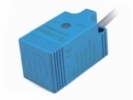
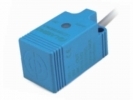
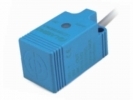
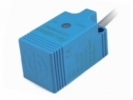
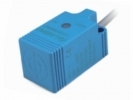
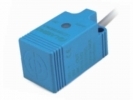
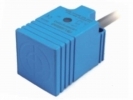
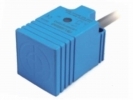
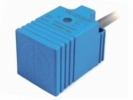
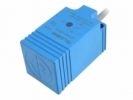
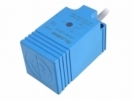
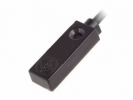
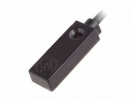
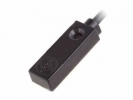
Rectangular inductive sensors can be advantageous where the machine design does not allow a cylindrical housing or where a different active surface size and mounting method are required.
LANBAO cylindrical inductive sensors
Most common applications of inductive sensors
- detecting the end position of a mechanism,
- checking the presence of a metal part,
- counting metal products,
- monitoring the position of a cam or gear,
- checking the extension or retraction of a mechanism,
- automatic production and assembly lines,
- conveyors and handling systems,
- robotic applications,
- machine tools and special-purpose machines.
What to check when replacing an old inductive sensor
A mechanically similar sensor may not be electrically or functionally compatible. When looking for a replacement, compare at least:
- order code and manufacturer,
- diameter or dimensions of the housing,
- flush or non-flush version,
- sensing distance,
- supply voltage,
- PNP or NPN,
- NO or NC,
- maximum output current,
- cable or connector,
- number of pins and pinout,
- switching frequency,
- protection rating and operating temperature.
Diagnostics – the inductive sensor does not work
| Problem |
What to check |
| The sensor LED does not light up |
Power supply, polarity, distance and target material |
| The LED responds, but the PLC does not |
PNP/NPN, NO/NC, pinout, cable, common potential and PLC input |
| The sensor is permanently switched on |
Surrounding metal, metal chips, mounting and a possible short circuit |
| The sensor occasionally misses |
Sensing distance margin, vibration, target size, speed and PLC filter |
| It does not work after replacement |
PNP/NPN, NO/NC, voltage, pinout and compatibility of the new type |
LANBAO and TECHNOLINE inductive sensors
TECHNOLINE offers inductive sensors for standard and special industrial automation applications. For individual products, always check the specific technical parameters, availability, connection method and data sheet.
LANBAO cylindrical sensors | Factor 1 | Analogue | Two-wire | High-pressure | High-temperature
Training program – inductive sensors from principle to your own application
For training, application design and a practical understanding of how inductive sensors work, you can also use the TECHNOLINE / LANBAO training program. It covers the principle of inductive detection, sensor selection, PNP/NPN, NO/NC, mounting and connection to a PLC.
Training program – inductive sensors
Frequently asked questions about inductive sensors
What is an inductive sensor?
An inductive sensor is a non-contact electronic sensor designed primarily for detecting metal objects. It detects a change in the electromagnetic field caused by an approaching metal.
What can an inductive sensor detect?
Inductive sensors are used primarily for detecting metals. The actual sensing distance may depend on the type of metal, the size and shape of the target and the specific design of the sensor.
What is the difference between a PNP and an NPN inductive sensor?
When activated, a PNP output typically supplies a positive potential, while an NPN output typically pulls the signal towards 0 V. The correct type must match the input wiring of the PLC or control system.
What is the difference between NO and NC?
NO is usually inactive without a detected target and switches on upon detection. NC works the opposite way. Some four-wire inductive sensors provide both outputs.
What do flush and non-flush mean?
Flush refers to an embeddable version that, according to the specification, can be mounted with metal around the active part. Non-flush refers to a non-embeddable version that needs free space around the active head.
Which inductive sensor to choose – M8, M12, M18 or M30?
Choose the size according to the available space, the required sensing distance, mechanical robustness and mounting method. M8 is compact, M12 is very universal, and M18 or M30 are used where a larger and more robust version is appropriate.
Is the Sn value a guaranteed operating distance?
Sn is the nominal sensing distance. To design a reliable application, it is necessary to take into account the operating range stated by the manufacturer, the target material, mounting, mechanical tolerances and operating conditions.
How to choose a cable for an M8 or M12 sensor?
Check the connector size, number of pins, connector gender, straight or angled version and, above all, the pinout of the specific sensor. The same connector size does not automatically mean the same electrical wiring.
Why does an inductive sensor respond differently to aluminium than to steel?
Different metals affect the electromagnetic field in different ways. Therefore, a standard inductive sensor may have a different effective sensing distance for steel, stainless steel, aluminium, brass or copper. For applications with different metals, Factor 1 sensors can be considered.
Choose an inductive sensor according to your application
When selecting, start with the sensor size and the required sensing distance. Then choose a flush or non-flush version, PNP/NPN output, NO/NC function and connection method. For a sensor with a connector, do not forget to order the matching cable.
View all inductive sensors | Cables and connectors for sensors
Technical note: The information provided is for guidance when selecting. Always verify the wiring, limit values, sensing distance, operating conditions and other technical parameters using the current data sheet of the specific product.