Illuminated push buttons, mounting 22 mm
An illuminated push button combines an actuating surface with light information. However, these two functions need not be electrically or logically identical. Pressing may enter a request, while the light confirms readiness, acceptance of the command or an achieved state. Before selecting, therefore, write down the meaning of the light switching on and off. The operator must know whether they see a request or the actual response of the equipment.
Specific assemblies and their supply
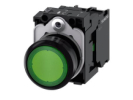
The range includes, for example, the green EMAS B190DY with one NO contact and an LED for 12–30 V AC/DC. The light supply is confirmed by the manufacturer's sheet B190DY. This range cannot be automatically transferred to other green actuators of the same size.
The green B1Y0DY also has one NO contact, but its LED is designed for 100–230 V AC. The difference is documented by EMAS specification B1Y0DY. The same colour or front dimension therefore does not mean electrical interchangeability of the light parts.
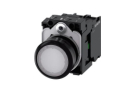
Also represented is Siemens 3SU1102-0AB60-1BA0. It is a white flat momentary actuator with a holder, an NO contact and an integrated LED; the assembly is described by the manufacturer Siemens. When replacing, check the complete order code and the module versions, not just the word “illuminated”.
Contact load and LED consumption
Assess the contact block and the illumination as separate parts of the design. The permitted contact load does not specify the light consumption; conversely, the LED supply range does not determine what load can be switched by the contact. For the contact, check the voltage, utilization category and type of load. For the light, the voltage, AC or DC, power or current and connection conditions. Separately check compatibility with the output that is to control the light.
For the same place on the panel, a separate status display and Non-illuminated push buttons. If the design uses a different mounting dimension, compare Illuminated push buttons, mounting 30 mm. However, switching to a different size does not solve electrical compatibility and does not automatically allow the same holders to be used.
Model example: panel lighting budget
Consider eight light branches, each with a model consumption of 10 mA at 24 V DC. When all are lit at the same time, the total is 8 × 10 = 80 mA and the electrical power is 24 × 0.08 = 1.92 W. A design reserve of 25 % would mean a budget of 100 mA for this subgroup. The values are chosen to explain the procedure, not taken from the consumption of the listed push buttons.
In a real panel, the limit consumption of the specific modules is used and other loads are added. At the same time, the current of each output and of the common output group is verified. A satisfactory total at the power supply does not prove that each control branch can safely supply its load. Nor does the stated reserve replace an assessment of inrush and operating conditions.
Mounting and FAQ
Before fitting, check the cut-out, panel thickness and space for the contact and light parts. The check after mounting must separately confirm the correct command and correct signalling. The protection rating of the front part is not by itself the protection rating of all rear connections and the whole enclosure.
Does an unlit push button mean the equipment is de-energized?
No. The cause may be an inactive signalling command, a light fault or an interrupted light branch. The illumination state is not a verification of the de-energized state.
Must the push button light up while pressed?
Not necessarily. It depends on the designed meaning of the signalling. A practical test should also verify the situation where the command is accepted but the required process has not yet started.
If you cannot find the item you need in the e-shop, contact us with your enquiry and the complete specification of the required version.