Level sensors and probes
Level can be monitored as a limit state, a continuous height or a value converted to volume. These tasks require different solutions. A float can confirm that a sump is full, but on its own it does not create a continuous record of the stock. A continuous sensor, on the other hand, needs the correct reference plane and tank geometry if its reading is to be used for balancing.
The range includes EMAS SKF float switches, IFM PS hydrostatic probes, IFM LR and Siemens LR100, radar devices, Siemens Probe LU240 and Endress+Hauser FMU41 ultrasonic devices, and the Liquiphant FTL51. vibrating limit switch. These are different measuring principles, not interchangeable probes with universal accessories.
For mechanical limit detection, continue to the subcategory Float switches; other measuring versions can be found in the branch Level sensors. In both cases, choose according to the medium, mounting space and the required signal.
What the individual principles measure
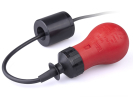
IFM PS3208 submersible probe is offered with a range of 0–0.25 bar and a 3 m cable. Hydrostatic measurement evaluates the liquid pressure above the diaphragm. When converting to height, the density of the medium and the pressure above the level are decisive; the cable length is not a measuring range value.
IFM LR3000 is a guided wave radar. An electromagnetic pulse travels along the probe and returns from the medium interface. The choice of rod or coaxial assembly depends on the properties of the liquid and installation conditions; accessories cannot be chosen only by tank length.
Non-contact radar and ultrasound evaluate the reflection from the surface, but do not use the same waves. When designing, watch for foam, steam, condensation, agitators and obstacles in the measuring space. False reflections from the structure cannot be corrected merely by rewriting the volume scale. A float, in turn, needs free mechanical movement; the cable, wall or deposits must not prevent it from tilting.
Tank, medium and connection
In an open tank, the hydrostatic overpressure can be referenced to the ambient atmosphere. In a closed pressurised vessel, the gas pressure above the level is added. Without taking it into account correctly, the device cannot distinguish a change in height from a change in this pressure. For the related reference measurement, open the category Pressure sensors. Design the compensation method for the specific system, not by automatically subtracting two arbitrary sensors.
For the submersible version, check the diaphragm, seals and cable sheath; all of them may be wetted. If the probe uses a vent capillary, the termination must maintain the pressure reference and at the same time prevent ingress of moisture according to the manual. The degree of protection of the probe itself is not permission to submerge any cable joint. Separately assess cleaning chemicals, temperature and deposits on the sensitive surface.
During commissioning, verify zero, the upper working point and a reserve for surface waves. For pump switching, set the difference between the switch-on and switch-off levels so that normal surface movements do not cause frequent cycling. These limits must also respect the sump volume and pump operation.
Model calculation: influence of density
Assume an open tank, a homogeneous liquid and a measured hydrostatic overpressure of 0.20 bar, i.e. 20 000 Pa. For a model density of 1 000 kg/m³, h = p/(ρg) = 20 000/(1 000 × 9.81) ≈ 2.04 m. At a density of 850 kg/m³, the same pressure corresponds to approximately 2.40 m. The difference of about 0.36 m arises from a change of medium, not a change in the pressure signal. This is a physical model, not a declaration of the range or suitability of a specific probe for oil.
FAQ
Why does the level height not correspond to the litres in the tank?
Neither a horizontal cylindrical tank nor a tank with a conical bottom has a constant horizontal cross-section. You need a geometric or verified conversion table. Do not forget the sensor position, the unusable residue and the working range below the maximum permissible level.
Can a float switch a pump directly?
The current rating of the contact alone is not enough. Compare the permissible type of load with the motor start-up and the design of the switching circuit. The necessary contactors, fuses and protections are determined as a whole; they cannot be derived just from the number of wires of the float.
Is one sensor at the same time independent overfill protection?
Two set limits on one device do not create two independent measurements. A protective function must be addressed by a separate design. For links to control, alarms and other quantities, use the overview Process Sensors.