Cable conduits and accessories
A cable conduit provides mechanical protection for the wiring and helps keep its route between the individual points of the installation. The selection starts with the cable and the environment, continues with the tube size and ends with compatible holders and end fittings. The conduit alone does not handle every entry into equipment; the route is terminated with fittings for cable conduits. For direct passage of the cable alone through a wall, a different group is used: cable glands.
Inner and outer diameter play a different role
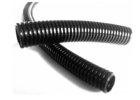
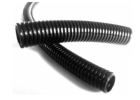
Among the items offered are the black ORTAC conduit OSPA07 and the separate grey holder ODGK-28. For the conduit, the inner dimension is assessed for passing the cable, the outer dimension and corresponding profile for connecting accessories. The ORTAC dimension tables distinguish the inner and outer dimensions of the individual sizes. Choose the corresponding version according to the complete conduit designation.
The presence of two items in the same category does not mean they form a mutually compatible pair. For the holder, check the size, design purpose and closing method. For the fitting, it also matters how it grips the conduit profile. A mere match of the approximate diameter does not guarantee sufficient retention or tightness.
Space for the cable is not just a sum of areas
When planning the passage, work with the outer diameters of the cables, not with the copper cross-sections of their cores. Take into account ovality, tolerance, any joints and pre-assembled connectors. A cable that would pass through a straight tube on its own may be difficult to pull through several bends. Determine the appropriate reserve and permissible fill according to the specific system, not according to a single universal rule.
Model example: the area works out, the geometry does not
Consider two model cables with a circular outer diameter of 4 mm and a circular conduit with an inner diameter of 6.5 mm. The sum of the cross-sectional areas of the cables is approximately 25.1 mm², while the area of the opening is approximately 33.2 mm². A comparison of areas might therefore look favourable.
However, two intact circular cross-sections with a diameter of 4 mm need at least 8 mm side by side even before adding mounting clearance. They will not fit into the stated opening. The calculation illustrates a geometric error in selection, not the permissible fill of an actual product. Compressing the sheath is not a substitute for the correct route size.
Fixing, bending and maintenance
Prepare the routing so that the conduit does not collide with edges, moving parts or service access. Determine the spacing of supports and the minimum bend according to the documentation of the specific version. A plastic tube may be flexible during installation without being designed for constant machine movement. For such a task, also assess flexible cable chains and cables approved for the given movement.
Include both ends of the route and all necessary holders in the material list. When replacing a cable, a record of the conduit size and places of difficult passage helps. A damaged end or holder is not assessed only by appearance; it may change how the mechanical load is transferred.
FAQ
Is a closed conduit automatically watertight?
No. The joints, end fittings and mounting conditions are also decisive. The protection rating is not taken from the material name or the appearance of the tube.
Can I choose a holder just by its colour?
No. Colour does not prove size or profile compatibility. What matters is the dimensional and design match with the conduit.