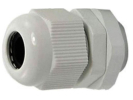
Cable glands
A cable gland handles the entry of a cable into an enclosure or other equipment. The right choice matches the size of the cable sheath with the specific mounting hole and environmental conditions. It is not determined only by the cross-section of the cores. If you are terminating a protective tube instead of a cable, choose different fittings for cable conduits; other related parts are in the overview of electrical consumables.
Two thread series in the range
The category includes grey EGTECH glands with threads PG9, PG11, PG13.5, PG16, PG21 and PG29 and metric versions M12, M16, M20, M25 and M32 with a pitch of 1.5 mm. Choose the thread according to the actual counterpart, not according to a similar outer diameter or a number in the name.
PG and metric threads are different interfaces. The manufacturer's ABB cable gland catalogue distinguishes them separately; any reducer is another specific component, not an automatic property of the gland. For a hole without a thread, the fixing method, space for the nut and appropriate wall thickness must also be resolved.
The cable sheath matters, not the total copper
For the sealing part, you need the outer diameter and shape of the cable. Two cables with the same core cross-section may have a different sheath and therefore require a different gland size. Look up the clamping range for the specific item and compare it with the cable tolerance as well. The nominal thread M16 by itself does not determine this range.
The relationship between cable, seal and mounting interface is summarised in the LAPP gland selection guide. These are general selection criteria, not a data sheet for the EGTECH products offered here. Therefore document the required properties for the exact product and the way it is used.
What to prepare for mounting
In the design, record the available space outside and inside the enclosure. The gland body, nut and cable bend have their own space requirements. Holes placed too close together may hinder tool access even if they fit dimensionally into the wall. Take tightening conditions from the relevant instructions; a general torque for all plastic glands cannot be specified.
Assess the mechanical strain relief of the cable and the seal against the wall separately. The protection rating of one component does not automatically describe the whole enclosure after mounting. An ordinary round seal opening is also not a universal entry for two separate cables. A multi-cable solution needs a design intended for such an arrangement.
Model example: checking the dimensional tolerance
Consider a cable with a model outer diameter of 7.2 mm and a manufacturing tolerance of 7.0 to 7.4 mm. A thread of M16 × 1.5. is specified in the enclosure. The selection must meet both conditions: the correct thread and a documented sealing range covering the full cable tolerance.
The designation M16 alone is not enough to decide. If the documentation contains only the thread without the cable range, the order brief is not yet complete. Also add the environment, wall thickness and the required method of mechanical retention. The example does not constitute a recommendation of a specific order code.
FAQ
Can a larger opening be solved by tightening harder?
No. An incorrect sealing range is not compensated by increased torque. The selection must match the cable and the mounting interface already before assembly.
Is a plastic gland also an EMC gland?
Such a function cannot be assumed. Connecting the shield requires an appropriate design and verified contact conditions; neither the appearance nor the thread proves them.