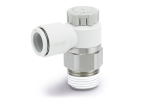
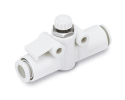
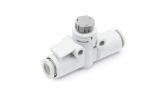
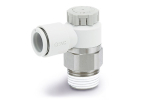
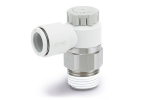
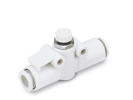
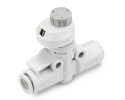
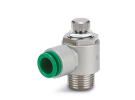
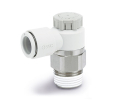
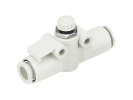
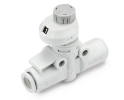
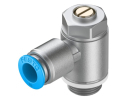
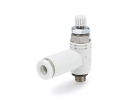
Flow control valves
The range includes the designations TJSC, TPA, THVFF, TERE, SMC AS and Festo GRLA. For selection, start with a diagram of the required movement: which stroke you need to slow down, where the air flows during it and where the adjusting element should be accessible.
Throttling direction and meaning of connection
A one-way flow control valve combines an adjustable passage with a check valve. It restricts one direction of flow and allows the opposite direction to bypass the throttling point. The meter-out version throttles the air leaving the cylinder, meter-in the supplied air. With the needle you set the flow restriction, not the required outlet pressure value. Evaluate the direction relative to the cylinder, not according to which side the tube points.
A specific pair is represented by AS1201F-M5-04A for meter-out throttling and AS1211F-M5-04A for meter-in throttling. The distinction is confirmed by SMC AS order key. The same connection size does not yet mean the same function.
Selection according to the actual operating point
For AS, assess the connection thread, tube outer diameter and flow characteristic separately. The manufacturer's graphs state an inlet pressure of 0.5 MPa and a flow rate in litres per minute ANR. Such a value cannot be transferred to another circuit without the stated conditions. The number of needle turns is not a scale of cylinder speed.
Mounting, adjustment and finding the cause
Instructions SMC for elbow and universal AS require checking the flow direction and tightening by the specified hexagon near the thread. Do not turn the knob with pliers or force it past the stop. Start adjustment with the needle closed and open gradually; reversed orientation can cause unexpectedly fast movement.
If the speed does not change when turning, check the orientation of the check valve. If the setting fluctuates, check its securing; for the version with a lock nut, its tightening. When looking for the cause, compare both directions of movement and record which setting change the actuator responds to. Choose the specific intervention procedure according to the instructions of the given variant, as the individual versions have different instructions.
Our own model: velocity is not catalogue flow rate
Let us consider only a model cylinder with a piston diameter of 40 mm, a stroke of 200 mm and an extension time of 0.8 seconds. The average speed is 0.20 / 0.8 = 0.25 m/s. The piston area is approximately 1 257 mm² and the displaced geometric volume 0.251 litres. This gives an average volumetric flow rate in the chamber of 0.251 × 60 / 0.8 = 18.8 litres per minute.
Let us further assume a constant absolute chamber pressure of 7 bar and a reference pressure of 1 bar at the same temperature. The ideal conversion gives approximately 132 reference litres per minute. This is not the ANR definition or a value of a specific valve. The model neglects filling of dead volumes, pressure changes and start-up. It shows why it is necessary to compare flow rates at the same reference state and why the value of eighteen litres alone is not enough for selection.
For your own acceptance test, we recommend recording the time of each stroke separately, the adjustment position and the pressures during movement. Record the static pressure separately so that it is not confused with the pressure during flow. Repeat the same load and the same order of measurements. To compare several settings, determine an acceptable stroke time interval in advance. Also record the slowest and fastest repetition, not just the average. The difference between them will show whether the chosen operating point meets the required repeatability. This creates a usable record of the setting instead of an estimate by sound; the related exhaust is addressed by Silencers.
FAQ
Does a tightened needle close the supply without leakage?
SMC does not define this AS as a shut-off valve with zero leakage. Do not try to achieve tight closure by overtightening the needle.
Can the number of turns be taken over from another machine?
Only as an initial record, not as a verified speed. The flow characteristics are representative; verify the resulting movement in your own circuit.