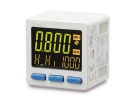
Pressure sensors
A pressure sensor can monitor a pneumatic circuit, monitor vacuum when gripping a part or provide a continuous value for process control. Each of these tasks places different demands on range, dynamics and output. For correct selection, first determine what pressure is measured, against which reference and with which medium the device will be in contact.
The range includes, among others, the IFM PA3029, vacuum sensor, Ema PB1101, SMC ISE30A-01-E and Cerabar M PMP51. process devices. These items represent different versions. The series names alone do not determine the measuring range, switching logic or communication interface of a specific unit.
For selection within individual families, use IFM pressure sensors, EMA pressure sensors and THERMOKON pressure sensors. When comparing, keep the same units and pressure reference; an identical numerical range alone does not prove interchangeability.
Absolute, relative and differential pressure
Absolute pressure is referenced to vacuum. Relative pressure is the difference from the ambient atmosphere and can be positive or negative. Differential measurement compares two pressure inputs, for example upstream and downstream of a filter. The word vacuum usually describes negative relative pressure; without stating the reference, the number alone is not sufficiently unambiguous.
The pressure reference is not the same as the sensing principle. A ceramic cell or a metal diaphragm converts the pressure load into a measurable change, but their material alone does not determine whether the device measures absolutely or relatively. Nor are two separate relative sensors automatically an equivalent replacement for a differential device: when subtracting, the errors and timing differences of both channels apply.
IFM datasheet PA3029 states a relative range of −1 to 0 bar. Steel 1.4305, ceramic and FKM are listed as wetted materials. This is a different list from the outer housing materials; it is the wetted parts that are decisive for assessing chemical compatibility.
Model calculation: reference conversion
Assume, for illustration only, a local atmospheric pressure of 1.00 bar and a relative reading of −0.60 bar. The absolute pressure is p_abs = p_rel + p_atm = 0.40 bar. When the ambient pressure changes to 0.98 bar and the relative reading remains −0.60 bar, the absolute value will be 0.38 bar. The model shows why it is not correct to add a fixed one bar to every relative measurement without verification. This is not a prescribed working point of any product.
Range, pressure surges and medium
The measuring range indicates the area in which the specified value can be evaluated. The permissible overload determines another limit, and the burst pressure is not an operating limit. Rapid valve closure or pump pulsation can create peaks that slow recording does not capture. Design protective elements according to the nature of the process; they may also slow down the measurement response.
Carry out the material check for the medium and cleaning. Assess the diaphragm, seals, process connection and any fill fluid if the assembly uses one. The designation stainless steel does not describe one universal chemical resistance. For viscous or crystallising substances, the shape of the face and the risk of clogging the inlet port may be important. Verify the mechanical connection including the sealing surface, not just by the thread diameter.
How to connect the measurement to the control system
PB1101 is described in the range for 0–2 bar with a 4–20 mA current output. Identical ranges are not enough for connection: the input must match the electrical wiring of the sensor and the entire loop. For a switching output, polarity, permissible load, switching limits and hysteresis are decisive.
After mounting, verify zero, the control system scale and behaviour with the sensor disconnected. In hydrostatic conversion, pressure does not determine height without knowing the density and pressure above the level; the related selection is explained by Level sensors and probes.
FAQ
Is an excessively large range a safer choice?
It can provide a reserve but impair usability at the normal working point, especially with an error related to the full span. Therefore assess range and overload capacity separately.
Can any sensor be used for oxygen or a protective function?
No. The specific medium, cleanliness, design and required function must be explicitly covered by the documentation of the exact version. General catalogue classification does not prove such suitability. For related quantities, continue to the overview Process Sensors.