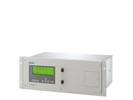
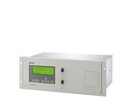
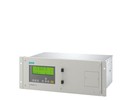
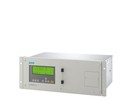
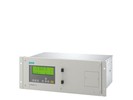
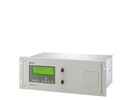
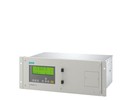
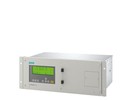
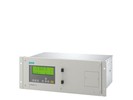
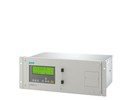
ULTRAMAT 23 — Multi-component Gas Analyser
ULTRAMAT 23 should be selected as a specific combination of measured components. The designation multi-component does not mean that each unit measures all gases in the catalogue. The public range includes, for example, 7MB2335-0AH06-3AA1, 7MB2335-0AM16-3AA1 and 7MB2337-0AH06-3PT1. When comparing assemblies, start with a list of the required quantities and determine which are to be obtained simultaneously from the same sampling point.
Infrared absorption and additional sensors
The infrared section uses the single-beam NDIR principle: the gas in the measuring chamber absorbs characteristic regions of infrared radiation and the detector evaluates its attenuation. Multi-layer detectors limit cross-sensitivities. Siemens ULTRAMAT 23 overview states various combinations of detection methods. Oxygen is not measured by this IR channel; depending on the configuration, a separate electrochemical or paramagnetic sensor is used. Other variants have, for example, an H₂S sensor or a UV module.
The specific principles and the AUTOCAL function are explained in the Siemens ULTRAMAT 23 manual. AUTOCAL uses the prescribed zero gas and adjusts the characteristic according to the given configuration. It does not replace verification of the entire measuring task with a reference mixture. Therefore do not take over the gas composition for AUTOCAL or its timing from another assembly.
One sample conditioning can affect several results
For each installed sensor, verify the requirements for humidity and accompanying components. According to the manual, the electrochemical oxygen sensor has its own conditions and is not intended for a completely dry sample. The recommendation "dry as much as possible" is therefore not universal. For the IR section, take into account overlapping absorption bands and matrix changes.
A cooler can remove part of a water-soluble measured component together with the condensate. This mechanism is documented by the sample conditioning manufacturer Bühler Technologies using the example of SO₂. For the project, this results in a requirement to evaluate the representativeness of the sample for all monitored gases. Better conditions for one sensor must not be considered better conditions for the whole assembly without verification.
Author's example: two valid readings need not be simultaneous
Consider a hypothetical evaluation of the ratio of two components. Before the process change, component A has a concentration of 100 ppm and component B 10 vol. %. After the change, the concentrations are 200 ppm and 20 vol. %. After converting B to ppm, the A/B ratio in both steady states is 0.001. However, if the new reading of A and the old reading of B enter the calculation, the result is 200 / 100 000 = 0.002,, i.e. double.
The numbers are not ranges of ULTRAMAT 23 nor a statement about the specific delay of its channels. It is the author's model, which explains the need to align the time and validity of data. During acceptance, therefore, also verify the behaviour of subsequent calculations during sample switching, stabilisation and calibration. The same display with several values does not yet determine how the higher-level system handles them.
Mounting, data transfer and common mistakes
In the assembly drawing, mark the gas paths according to the actual connection of the supplied variant. Decide in advance where the verification mixture will be supplied and where the service point will be accessible. For multi-component measurement, we recommend an acceptance table with a separate row for each gas: unit, concentration basis, expected result, test time and channel status.
For the operators, describe what the data mean during AUTOCAL and when the process value is usable again. Also agree on the procedure after replacing a sensor or modifying the sampling route. A common mistake is to recalculate all channels together, even though a change in settings or conditions affected only some of them. Therefore keep the initial configuration as part of the handover documentation.
FAQ
Does every variant contain an oxygen sensor?
No. The presence, type and usability of an additional sensor are verified in the specific configuration. The trade designation of the series is not a list of equipment.
Which related devices should be compared?
For a different concept of infrared measurement, examine ULTRAMAT 6E. Separate oxygen measurement is represented, for example, by OXYMAT 61; suitability for the given matrix is assessed separately.