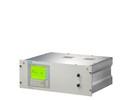
OXYMAT 64 — Trace Oxygen Analyser
When measuring trace oxygen, even a very small admixture of ambient air is decisive. OXYMAT 64 should therefore be selected together with the sampling route, fittings and the method of verifying tightness. The public range in this category includes 7MB2041-0AA10-1AA1. Always link the specific range, pressure version and sensor to the complete order number and documentation of the device supplied.
Zirconia cell and partial pressure
A heated ZrO₂ cell generates a voltage according to the logarithmic ratio of the partial pressures of oxygen in the sample and the air reference. The principle is explained in the Siemens OXYMAT 64 manual.
CAZ is catalytically active and permits only non-flammable accompanying components. CIZ limits catalytic reactions, but residual influences of H₂, CO and CH₄ remain.
Sample, mounting and zero verification
The sample must be clean and sufficiently dry according to the manual. The lower calibration point requires a known low O₂ content, not simply pure nitrogen. The rack needs support and distance from interfering magnetic fields.
For the project, prepare a list of all places where the route can be opened: sampling fitting, filter, switching valve, calibration inlet and analyser connection. For each point, determine how the return to the original result will be verified after an intervention. Consider whether the verification gas can be supplied upstream of the entire route. A check only at the device inlet does not cover the upstream parts of the sampling.
Author's example: a tiny admixture of air
Consider ideal mixing of 1 000 ml/min of oxygen-free gas with 0.10 ml/min of air. For this calculation, we round the oxygen content of air to 21 %. The admixed oxygen therefore represents 0.10 × 0.21 = 0.021 ml/min. After dividing by the total flow of 1 000.10 ml/min and multiplying by a million, approximately 21 ppm O₂ results.
The input flows are the author's assumptions for a balance demonstration, not recommended flows for OXYMAT 64. The model assumes the same pressure and temperature conditions for both streams and neglects all other sources of oxygen. It shows why an almost imperceptible admixture can significantly affect trace measurement. The result cannot be used as a universal permissible leak rate or as proof of sensor accuracy.
The practical consequence is simple: before requesting a finer range, first design how you will distinguish oxygen originating from the process from oxygen introduced by sampling. For the same sampling point, for example, determine in advance a comparison of results before and after a service disconnection. The verification criterion must match the process requirement.
The same balance allows two hypothetical service states to be compared without assuming sensor properties. With an air admixture of 0.05 ml/min, approximately 10.5 ppm would result under the same assumptions. Half the admixture gives almost half the contribution here, not automatically better device accuracy. The difference is a consequence of the chosen mixing. The report should distinguish actually measured values from such calculated estimates so that a model figure does not mistakenly become an acceptance limit.
What to record during acceptance
Record the identification of the calibration cylinder, the declared concentration and uncertainty, the connection method and the course of stabilisation. Agree which result will be considered stable and how long a record will be kept. A common mistake is to evaluate only the last digit of the display and omit changes after switching gas. Another mistake is to take over the parameters of the pressure version from a similar-looking device. Therefore add the identification of the actual variant to the assembly drawing, not just the family name.
FAQ
Does a low reading automatically mean cleaner process gas?
Not always. In the event of an unexpected change, also check the matrix composition, the selected cell and the measuring path. The reading alone does not explain the mechanism of the change.
When to consider the paramagnetic series?
For a different concentration level and different composition, compare OXYMAT 61. The context of selection can also be found in the category Siemens gas analysers. A lower numerical range does not in itself determine suitability for the application.