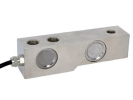
Strain gauge sensors
Choose a strain gauge sensor according to how the load enters it. For a weighing platform, the mounting and the size of the superstructure are important; for a tensile test, the alignment of the loading chain. This branch includes, for example, BCM 1661, SMOWO LCS-D1 and LCS-S3. The same electrical signal does not yet mean a mechanically interchangeable product. We also use strain gauge sensors in our custom-built machines for customers.
Platform weighing or tensile force measurement?
BCM 1661 is a single point sensor with a parallel bending beam. Its design is intended for platform weighing; the drawing distinguishes the fixing of the fixed and loaded part. Before designing the platform, also compare its permissible size and mounting method. Details are contained in BCM 1661 datasheet. The free deformation space must not be bridged by a stop, cover or an improperly placed screw.
SMOWO LCS-D1 is one of the weighing sensors. The manufacturer states a sensitivity of 2.0 mV/V with a tolerance of ±10 % and an excitation of 5–12 V DC; therefore do not set the specific conversion only according to the rounded catalogue figure. The data are based on dokumentace LCS-D1. The LCS-S3, series, which the manufacturer describes as an S-type sensor, is intended for measuring both tension and compression; see SMOWO documentation LCS-S3.
The range must also include the container and fixture
Write down the maximum load, the weight of the platform and container and the forces arising when placing the product. An impact is not the same as slowly placing the same load. For a weighing assembly with several supports, consider uneven load distribution. Conversely, an excessively large range reduces the proportion of the signal used in normal operation.
Also verify the mounting with a simple operational test: does the container touch the surrounding frame, does a hose pull on it, or does the cable catch on the cover? Such couplings can change the reading without a change in content. For a tensile fixture, check the alignment of the threaded joints; side loading cannot be corrected by readjusting the gain.
Electrical connection and actual sensitivity
A bridge output in mV/V requires a suitable strain gauge amplifier. Compare its input range with the sensitivity of the specific unit and the actual excitation. The permitted sensor voltage must not be confused with the supply of the entire switchboard. To calculate the load on the excitation source, use the input resistance of the bridge.
With four-wire wiring, separate the excitation pair from the measuring signal pair. A separate sense pair is only considered where both the sensor and the evaluation support it. Handle the wiring and any cable extension according to the specific diagram; after any intervention, verify the entire assembly. The relationships are summarised by the sensor and amplifier guide.
Model example of a platform scale
Consider a design with the LCS-D1 variant for 20 kg. For the calculation itself, assume an exact sensitivity of 2 mV/V, 5 V excitation, linear response and a zero signal from the unloaded sensor. The container with platform weighs 2 kg, the added material 6 kg. The total load of 8 kg corresponds to 40 % of the range and a signal of 4 mV. The empty assembly produces 1 mV; after taring, the increment of 3 mV represents 6 kg of material. Mechanically, however, the sensor still carries 8 kg. For an actual unit, use the determined sensitivity and calibration.
FAQ
Does setting zero solve inaccurate weighing?
Zero removes the offset at one working point. Verify the correctness of the range with an independent reference load, ideally also between the end points and after unloading. If the reading changes with the position of the load, first check the mechanical mounting.
Why does the reading still change after the load is placed?
Monitor separately the mechanical settling, the change in response over time under constant load and the set filtering. For comparable results, read after the same time; slow weighing and capturing a fast impact have different requirements.