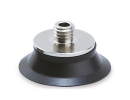
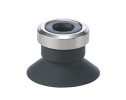
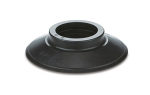
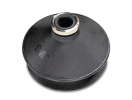
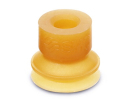
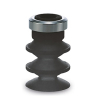
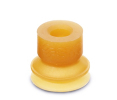
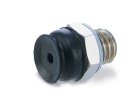
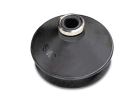
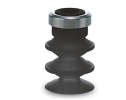
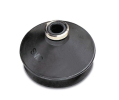
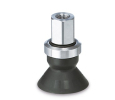
Pneumatic suction cups
The suction cup creates contact between the part and the vacuum circuit. Evacuating the air under the sealing lip creates a difference from the ambient pressure, which presses the part against the suction cup. This principle is explained by Festo in the vacuum technology overview. Actual contact with the work surface is decisive for gripping.
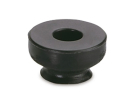
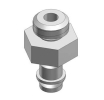
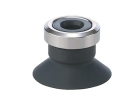
The listing includes the SMC ZP, ZP2, ZP3, ZP3E and ZPT series as well as holders. Examples from the range are ZP3-02UN a holder ZPT1-A5; their mutual compatibility is not confirmed by this.
Choice of shape and material
For ZP3, SMC distinguishes flat, grooved and bellows shapes. The flat shape is used for a straight undeformed surface; the bellows version is also used for inclined surfaces. Select the material according to the part, environment and the required behaviour after gripping. Always verify special suitability for the exact order code.
For your own comparison, prepare representative samples from several production batches and record the surface condition of each. Divide the test into seating, stabilisation, movement and release. For each phase, determine the observed result in advance, for example the position of the part after transfer or its release time. Also keep unsatisfactory results; a successful first attempt does not give an overview of process variability.
Mark the samples and keep their order when repeating. For each failure, record the observed state, not just the conclusion that the assembly does not work. Photos of the contact point and a record of the test will then serve as a basis for further comparison.
Mounting and replacement
Compare the holder with the suction cup according to the mounting interface. Look up the tightening torque for the specific thread and assembly in SMC mounting table. The manufacturer also distinguishes replacement methods according to design. After replacement, check the seating and securing of the suction cup; do not transfer the procedure of one type to all series.
Our own model of ideal pressure force
Let us consider a hypothetical closed circular effective area with a diameter of 30 mm and a uniform pressure difference of 50 kPa. Area A = π × 0.030² / 4 = 0.000707 m². From the definition of pressure as force per area, stated in the primary Festo overview, we get F = Δp × A = 50 000 × 0.000707 = approximately 35.3 N. With a model drop of the pressure difference to 35 kPa, the result is approximately 24.7 N.
This is the ideal normal force without a safety reserve. The diameter is not a value of any offered suction cup, and the calculation does not determine the load capacity or the order code. The actual effective area and permissible load must be confirmed by the documentation of the specific product.
SMC points out also on lateral forces and moments. The calculation therefore does not assess shear, peeling or movement with a displaced centre of gravity. It is not proof of safe holding of a load above persons.
Diagnostics after replacing a suction cup
If the fault appears after replacement, according to SMC diagnostic tables check the change in seating height, the joint between the suction cup and the adapter and leakage of the threaded connection. Record in which phase of the cycle the gripping deteriorates.
As our own acceptance procedure, we recommend comparing the record before and after replacement on the same samples and with the same motion program. Attach the assembly designation, date and change made to each result. Such a record allows the test to be repeated at the next repair and distinguishes a change of suction cup from a change of workpiece. Determine the number of repetitions according to the requirements of the specific process.
FAQ
Does the same diameter mean a direct replacement?
For ordering, compare the full code, interface and documentation of both variants. Make the decision only after verifying the whole assembly in the same work operation.
Is one successful gripping test enough?
Include all planned phases of the cycle and representative samples in the acceptance. Record the result against pre-defined criteria; one attempt does not prove repeatability.