Accessories
Choose relay accessories according to the task they are to perform in the assembly. A fixing part, a signalling module and an electrical jumper address different requirements. Therefore list each add-on separately in the assembly list, including its link to the relay or socket. This helps with initial fitting and when looking for a later replacement.
Deciding: retention, indication, protection, jumpering
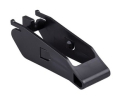
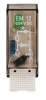
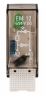
The range includes clips G4-1052 and GZT80-0040, modules M91G and M93G, combs ZG20-1 and ZG20-3 as well as EMAS add-ons RS2. Choose the base in the category Sockets. Verify the mechanical compatibility and voltage version of the add-on separately; the same brand alone does not replace a list of suitable combinations.
For each add-on, note the reason for use and the documentation that confirms it. Should it hold the inserted relay, indicate energisation, limit overvoltage or connect specified terminals? A single vague row “accessories” in the bill of materials does not distinguish these requirements and complicates acceptance of the assembly.
Principle of coil protection and the meaning of the indicator
The RELPOL module table distinguishes diode, RC and varistor elements. M91G and M93G belong to the LV version with indication and a varistor for AC/DC. Do not automatically confuse them with a diode alone or an RC element; the diagram of the specific module is decisive.
For coil overvoltage suppression, OMRON warns also of prolonged relay drop-out. For a diode element for DC, polarity is essential. Therefore assess the addition of protection together with the control output and the timing requirement of the machine. A universal procedure of connecting one type of element to any coil is not correct documentation.
Use the indication as a separate observation in the service record. Alongside the state of the indicator, record the command from the control system and the actual response of the load. Their agreement or difference will help describe the fault. However, do not replace the words “all OK” in the acceptance report with the light alone.
Author's model example: common supply
Assume six identical model branches, each with a steady-state current of 0.08 A. With all branches operating simultaneously, the sum is 6 × 0.08 = 0.48 A. This is our own calculation example, not the current capacity of a comb, socket or other product offered.
In the brief for the common supply, also record any different switch-on moments and the maximum simultaneous operation. Transfer the sum to the point through which the common current actually flows. Branches after the split have different current conditions than the supply before the split. The result does not replace checking the permissible combinations or assessing the protection.
Mounting of jumper elements
Interface data sheet PIR6W describes ZG20 as a jumper for common input or output signals. Before fitting, determine which terminals may be common. Use the comb colour together with the designation in the diagram; it does not by itself determine the electrical function of the connected circuit.
For the layout, prepare a list of the jumpered positions, their designations and the group boundaries. During future expansion, check whether the new branch belongs to the same circuit. Assess the space for the clip and module on the fitted assembly. Take instructions for fixing and electrical mounting from the documentation of the specific parts.
Diagnostics after adding accessories
If a change in behaviour appears after adding a module, record the original and new fitting and the timing. Subsequent professional verification should compare both configurations with the documentation. Choose a replacement relay only after determining the cause, not just according to the indicator.
FAQ
Does the coil module also protect the contacts against overload?
Its presence does not prove such protection. Assess the contact circuit and its protective devices separately.
Is the comb colour proof of correct jumpering?
No. The specific connection of the terminals, the equipment diagram and the permitted use of the jumper part are decisive.