Optoelectronic sensors have the longest range of all types — from a few centimetres to tens of metres. You will find three basic designs here: a diffuse sensor needs only one side and monitors the object directly in front of its face, a retro-reflective sensor works against a reflector and covers several metres, and a through-beam barrier with separate emitter and receiver units is the most reliable and reaches furthest. The range includes cylindrical and block designs, models with background suppression for precise definition of the working zone, red and infrared LEDs and laser sensors for small objects. You can choose by PNP or NPN output, light-on or dark-on switching, degree of protection IP67 and connection by cable or M8 and M12. connector. We supply sensors from Lanbao, TECHNOLINE, SICK, Balluff, IPF, IFM and others. If needed, contact us and we will be happy to help you choose the right type for your application.
PSM-YC10DPBR, LANBAO – diffuse photoelectric sensor with background suppression. Sensing distance: 100 mm; output: PNP; function: NO/NC; supply: 10-30VDC. Designed for detecting objects in front of a…
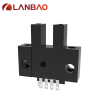
PU05-TDNB-R LANBAO – fork light barrier, 5 mm, NPN, NO/NC selectable by wiring, 2 m cable. Industrial product for automation, detection or measurement.
PU05-TDPB-T1, LANBAO – fork photoelectric sensor / light barrier. 5 mm; PNP; NO/NC selectable; 5–24 V DC; cable 1 m.
Na zapytanie
20,52 €
bez VAT · 24,83 € z VAT
Ceny zawierają opłatę recyklingową.
Photoelectric Sensors
Optoelectronic or optical sensors use light for non-contact detection of objects. The sensing principle is essential for selection: a diffuse sensor works with reflection from the object, a retro-reflective version with a reflector, and a through-beam barrier with a separate emitter and receiver.
How to choose an optical sensor
Compare the range, light spot size, colour and surface of the object, background suppression, response speed and the output for the control system. For transparent or shiny objects, verify the suitability of the specific model for this application. Choose optical fibres and their amplifiers as a compatible assembly.
For the connection, check the supply, PNP/NPN, switching function, number of wires and connector wiring. A standard optical sensor does not replace a safety light curtain designed for personnel protection.
Pliki cookies na tej stronie
Techniczne pliki cookies są potrzebne do działania koszyka i zamówienia — są używane zawsze. Analityczne pliki cookies pokazują nam, których stron ludzie szukają i gdzie się gubią, i pomagają nam ulepszać sklep. Użyjemy ich tylko wtedy, gdy na to pozwolisz. Więcej w zasadach przetwarzania danych.
Ustawienia cookies
Wybierz, których plików cookies możemy używać. Wybór możesz w każdej chwili zmienić.
Techniczne pliki cookies
Zawsze aktywne
Przechowują zawartość koszyka, logowanie i wybrany język oraz chronią formularze przed nadużyciem. Bez nich nie można złożyć zamówienia, dlatego są używane także bez zgody.
Analityczne pliki cookies
Usługa Google Analytics pokazuje nam ruch i zachowanie na stronie w formie zbiorczej. Dzięki temu wiemy, które strony nie działają dla ludzi. Na podstawie tych danych nikogo nie identyfikujemy.