Contactors and motor protection
Switching a motor and protecting it are two different tasks. A contactor handles operational commands, while a protective device responds to defined fault conditions. The right choice therefore does not start with a single figure in amps, but with a description of the load, the duty cycle and the supply system. In this category you will find EMAS and NOARK motor starters, power and auxiliary contactors and accessories for their control.
Which part of the assembly are you selecting?
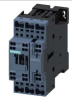
Separate branches are dedicated to manual control and protection of the motor feeder Motor protection (motor starters) EMAS and Motor protection (motor starters) NOARK. For operational switching and contact expansion, continue to Contactors and auxiliary contacts. The range NOARK contactors includes the Ex9C and Ex9CH series; for products of different design, always check the intended use, not just the similarity of the designation. A separate branch is formed by Siemens contactors.
When replacing an existing part, copy the complete order code including the suffix, coil data and contact configuration. Two devices of the same current size may have a different control circuit or mechanical accessories. A photo of the front helps with identification, but does not replace the rating plate, the equipment diagram and the dimension drawing.
Contactor, thermal relay and motor circuit breaker
A contactor operates its contacts electromagnetically and allows repeated remote switching. On its own it is neither motor overload protection nor a universal short-circuit breaker. A thermal overload relay monitors overload and initiates tripping via the downstream control circuit. It does not replace separate short-circuit protection; this boundary is described in Schneider Electric's explanation of the thermal relay.
A thermal-magnetic motor circuit breaker combines adjustable overload protection with a fast short-circuit release and manual operation. Other designs exist, however, so these functions cannot be attributed to every product generally called a starter. Remote operational commands are usually handled by a contactor, while the protective equipment must remain effective independently of the machine's normal program.
AC-1, AC-3 and the meaning of power in kW
AC-1 refers to non-inductive or slightly inductive loads, such as resistive heating. AC-3 describes starting a squirrel-cage motor and switching off a motor that is already running. The same contactor may therefore have a higher permissible current for AC-1 than for AC-3. The category is not a “quality grade” but a description of the switching task; see the manufacturer's explanation of categories AC-1 and AC-3.
The motor power stated for a contactor applies to the specified voltage and utilisation category. It is not the coil consumption, nor a universal limit for every motor of the same power. For frequent short jogging, plugging or demanding reversing, the corresponding duty must be verified; the usual AC-3 rating does not automatically apply to such a load. For installation relays, categories AC-7a and AC-7b. may also be decisive.
It is advisable to convert the duty cycle into a specific frequency. For example, four starts per hour in two-shift operation of eight hours each means 64 cycles per day. This total does not yet determine service life, but it provides the input for assessing switching and the maintenance plan. Also record situations where the operator repeats short commands more often than in normal production.
Protection current, coil and auxiliary contacts
For motor protection, compare the adjustable range with the motor current under the actual operating conditions and with the intended location of the protection. The upper limit of the series does not replace the range of the specific device. The run-up time and behaviour during repeated starting are also important; nuisance tripping is not solved by simply raising the setting above the permissible value.
Assess the coil control voltage separately from the main circuit voltage. The same number followed by AC or DC does not mean interchangeability. For the control output, check the coil requirements for pick-up and holding, any suppression and the drop-out time. Select auxiliary contacts according to the required NO/NC logic, the load and their belonging to the specific design series.
Short-circuit withstand is not a property of any combination
Type 1 coordination allows repair or replacement of part of the assembly after a short-circuit event. Type 2 requires suitability for further use under specified conditions; even here, zero contact welding or immediate restart cannot be promised without reservation. The difference is summarised in Schneider Electric documentation on coordination.
Verify the result for the specific protective device, contactor, any overload relay, voltage and prospective short-circuit current at the installation point. The same brand or a higher rated current of a part is no proof of coordination. The conditional short-circuit current of an assembly must also not be confused with the breaking capacity of a standalone circuit breaker.
Model example: motor and resistive heating
Consider our own calculation brief: a three-phase motor with a mechanical output of 5.5 kW, line voltage 400 V, efficiency 0.90 and power factor 0.82. The approximate current is I = P / (√3 × U × η × cos φ), i.e. approximately 10.8 A. A balanced three-phase resistive heater of 12 kW at the same voltage draws approximately 17.3 A.
The higher heating current does not by itself mean a more demanding motor switching task: we are comparing different utilisation categories. For the motor, the rated-plate current, starting and command frequency are also decisive in the actual selection; for the heater, its own operating character. The figures serve to explain the difference; they are not a selection of specific protection or wiring instructions.
Mounting and documentation for professional design
Before ordering, determine the available space, fixing method, access to terminals and cooling conditions. An add-on contact or suppressor may change the required installation space. Leave the assessment of protection, settings and commissioning of the mains circuit to a qualified person; a list of devices alone does not prove the properties of the finished control cabinet.
FAQ
Is it enough to choose a contactor by the power on the motor rating plate?
No. Add the voltage, current, utilisation category, duty cycle, control and protective combination. The same kW can lead to different device requirements.
Does an auxiliary contact confirm safe disconnection?
A standard auxiliary contact is primarily information for the control system. A safety feedback function or verification of the main contact state cannot be derived from the NO/NC designation alone.