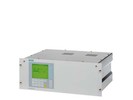
OXYMAT 61 — Oxygen Analyser (Paramagnetic)
OXYMAT 61 is designed for process oxygen measurement using the paramagnetic method. When choosing, consider not only the required O₂ concentration but also how the reference gas is supplied and the sampling conditions. The public range includes, for example, 7MB2001-0CA00-1AA1 and 7MB2001-1CA00-1AA1. However, membership of the series alone does not determine the equipment of all devices offered.
How the magnetic property is converted into a signal
Paramagnetic oxygen is attracted into a stronger magnetic field. The pressure difference relative to the reference causes a microflow. The flow changes the cooling of an electrically heated sensing element. The sensor lies in the reference flow; see the Siemens OXYMAT 61 manual.
The Siemens ordering table distinguishes between a pressure reference and an internal reference pump. The smallest measuring span is not the concentration of the reference.
Cross-sensitivities and installation preparation
The magnetic properties of admixtures affect zero; pressure also has an effect. The sample must be dust-free and free of condensation. The standard version does not permit flammable, toxic or corrosive gases. A rack requires support; the front panel is not enough.
Before mounting, create a diagram with separately marked sample inlet, reference and outlet. For each connection, add the expected pressure and its basis: absolute or relative. Add the service position and a description of the joints disconnected during replacement to the drawing. Check that the markings are legible even with the device inserted. During acceptance, ask the operators to identify the individual paths according to the documentation, not from memory.
Author's example: percent of span is not percent of reading
Consider a purely model specification of measurement from 0 to 20 vol. % O₂. For one part of the uncertainty budget, the designer chose a contribution of 1 % of this span. The calculation gives 0.01 × 20 = 0.20 percentage point of O₂. At a result of 4.00 vol. %, the same 0.20 percentage point represents relatively 5 % of the measured value.
None of these numbers is the accuracy of OXYMAT 61. The example only shows why it is necessary to read the basis of every percentage figure. The values 4.00 and 4.20 vol. % differ by 0.20 percentage point, not by 0.20 % relatively. Therefore write the acceptance requirement in specific units and at points important for the process. A common column called "accuracy in percent" is not enough.
Two columns can be added to the model acceptance sheet: the absolute difference in percentage points and the relative difference from the reference. For values close to zero, the second column has limited informative value; with a zero reference, the ratio cannot be calculated at all. Such a record makes it easier to compare offers that use a different percentage basis.
How to distinguish a device problem from a sampling problem
Design two consecutive tests. First, supply a suitable verification mixture to the prepared measuring path at the analyser and record the steady result. Then check the entire sampling route according to the project. Also compare the return time after switching. The difference between these tests will help determine which part of the assembly to examine further; on its own it does not yet determine the cause of the deviation.
Include the reference setting and filtration state in the report. Do not automatically attribute a change in the result after an intervention in sample conditioning to sensor drift. For repeated diagnostics, a complete record of conditions is more valuable than a single photograph of the display. Attach the original and new settings and the reason for the change; a later technician will then not have to guess whether the process, the customer's requirement or only the display method has changed.
FAQ
Does the internal pump automatically also pump the measured sample?
Not automatically; follow the actual gas diagram of the supplied assembly. Sample transport must be addressed separately in the specification.
Which series should be compared for another application?
To assess a corrosive matrix, continue to OXYMAT 6E, whose material version is verified separately. Other options can be found in the overview Siemens gas analysers.