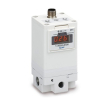
Compressed air pressure regulators
An air regulator maintains the set outlet pressure under the relevant operating conditions. The static reading on the pressure gauge and the pressure under consumption are not the same situation. For selection, compare the flow characteristic, inlet pressure and setting range.
Selection data Regulators
| Step |
What to document |
| Identification |
setting range and ports |
| Operating requirements |
peak flow and inlet pressure |
| Acceptance |
pressure under actual consumption |
Choose a regulator based on the required pressure at the consumer, not just on the diameter of the connection thread. Prepare operating specifications for rest, the normal working cycle and simultaneous consumption. For each state, we recommend recording the pressure upstream and downstream of the regulator. Such a record will help decide whether you are looking for a different setting range, a more suitable size or the cause of the problem outside the regulator.
Setting range and actual function
SMC AR-D is an air pressure regulator. Its standard table distinguishes the maximum operating pressure of 1.0 MPa from the setting range of 0.05 to 0.85 MPa. The proof pressure is not a permitted working setting. The offered AR20-F02GH-D assess according to the generation D documentation. Do not transfer the values to TEAR or to another AR generation.
The listing includes TEAR1000-M5, TEAR2000-02, TEAR3000-03, AR20-F01H-A and AR25-F02H-A; they are complemented by other regulating versions and pressure gauges. For a part with filtration, see the category Filter regulator. Before ordering, we recommend distinguishing the complete device, the combined unit and the separate gauge according to the full code.
Setting, mounting and measurement
The AR-D manual prescribes operating the knob by hand, reaching the target setting by increasing the pressure and then locking the knob. Before connecting, contaminants are removed from the piping and the interior is protected from sealing material. The tightening torque is chosen according to the specific connection. For service, first isolate the supply and verify depressurisation; normal adjustment is not a dismantling procedure.
For the G36-L and G46-L pressure gauges, the manufacturer relates the accuracy to the full measuring range, not to the value currently read. Coloured zones make it easier to navigate within the required band. For example, G36-10-01-L therefore also choose according to range and connection. Do not consider a change in scale colour to be a change in regulation properties.
Model calculation of the pressure balance
The following is our own measurement model, not a parameter of a specific regulator. At rest, let us assume 0.50 MPa at the outlet. At a specified consumption of 240 l/min with the same reference conditions, we measure 0.46 MPa downstream of the regulator and 0.42 MPa at the consumer. The difference between rest and the loaded outlet is 0.50 − 0.46 = 0.04 MPa. The simultaneous loss of the downstream branch is 0.46 − 0.42 = 0.04 MPa. The total difference from the rest value is 0.08 MPa.
The culprit cannot be determined from these three numbers. For the next step of the model, let us add a simultaneous measurement at the inlet: if the supply pressure also changes, we are already comparing two influences. We recommend evaluating the results with the same consumption repeated and recording the knob position. Simply increasing the rest setting would make it impossible to compare the original conditions.
For another example of our own, consider a gauge with a range up to 1 MPa and a permissible error of 2 % of the full scale. The absolute error limit is 0.02 MPa. Such a gauge cannot reliably distinguish a change of just one hundredth of an MPa. This is a hypothetical gauge, not a specification of the offered G pressure gauge.
How to compile a useful fault record
Divide the observations into a permanent fault and a fault linked to a certain phase of the machine. Note the time, active consumers and the reading point. The proposed procedure allows the supply, regulator and downstream branch to be compared separately. During the test, always change one condition; otherwise it may not be clear which adjustment affected the result.
FAQ
Does a regulator replace a relief valve?
SMC explicitly does not allow this for AR-A. Protection of the equipment against impermissible pressure must be based on the design of the whole circuit.
What data do I need to compare flow rates?
Request the characteristic for the intended inlet pressure, outlet setting and the reference flow conditions used. A number alone without an operating point is not enough for selection.
Primary sources: SMC AR-D, SMC AR-A, SMC G pressure gauges.