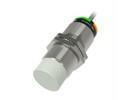
How to choose a capacitive sensor for material or level
A capacitive proximity sensor evaluates the change in capacitance around its active face. Depending on the design, it detects suitable metallic and non-metallic objects, plastics, glass, paper, liquids or bulk materials. When choosing, start with the task and the machine design: do you need to detect the presence of a product, check the contents of a package or monitor a point level?
| Version |
When to choose them |
What to compare |
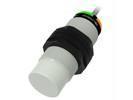
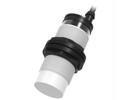
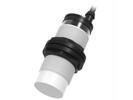
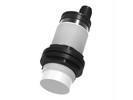
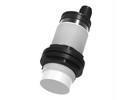
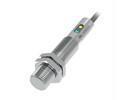
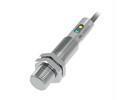
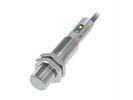
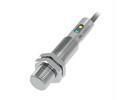
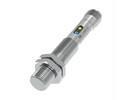
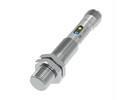
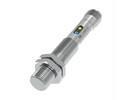
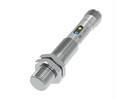
| Cylindrical capacitive sensors |
Detecting objects in front of the face of a threaded sensor |
M8, M12, M18 or M30; mounting and electrical output |
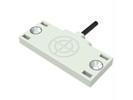
| Rectangular and flat capacitive sensors |
Flat installation and limited space at conveyors or brackets |
Position of the active face, dimensions and cable outlet |
| Capacitive level sensors |
Monitoring the presence of liquid in a vessel or pipe |
Medium, non-metallic wall, fixing and switching logic |
| Special capacitive sensors |
High-temperature location with a separate sensing head |
Limits of the head and amplifier, compatibility of the assembly |
Capacitive sensor: the range depends on the actual target
The rated sensing distance is determined under defined conditions with a reference target. The real range is affected by permittivity, the size and position of the material, as well as humidity or surrounding structures. A plastic part, a paper package and a container with liquid therefore each require their own verification. For stable detection, test the target state and the state without a target in the final installation.
Selected capacitive sensors detect contents through an electrically non-conductive wall. For such a task, compare the medium, the material and the wall thickness; a suitable group is capacitive liquid level sensors. A switching minimum or maximum monitor provides information that the level has been reached at the installation point.
PNP/NPN output and NO/NC contact
PNP or NPN determines the electrical design of the output and its connection to the PLC input. NO or NC indicates a normally open or normally closed function. Choose these properties separately, together with the supply, number of wires and connector wiring. For two-wire AC variants, also compare the load requirements according to the datasheet.
LANBAO, SICK, TECHNOLINE and EMAS capacitive sensors
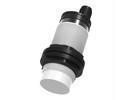
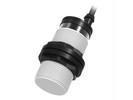
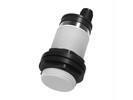
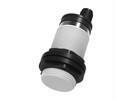
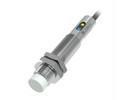
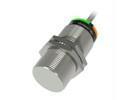
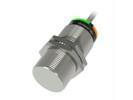
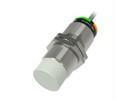
In the cylindrical design you can compare LANBAO CR12, CR18 and CR30, TECHNOLINE TSC sensors, the SICK CM/CMB series and EMAS SCM. An example of a M18 sensor is LANBAO CR18SCF05DPO. For low-profile installation, flat LANBAO CE05 and rectangular SICK CQ sensors are available. SICK CQF16 and LANBAO CE10/CE15 sensors handle level tasks; high-temperature CE53 assemblies have a separate head and electronics.
Frequently asked questions about choosing a capacitive sensor
What is the difference between a capacitive and an inductive sensor?
The capacitive principle allows detection of suitable metallic and non-metallic materials. Inductive sensors are designed for detecting metal objects. The choice depends on the target, range and environment.
Can a capacitive sensor be used through a vessel wall?
With a suitable model yes, through a suitable non-metallic wall. Usability must be confirmed by the combination of sensor, wall and medium in the real installation.
What should I specify when looking for a replacement?
Order code, housing dimensions, sensed material, working distance, mounting type, supply and output. For level applications, add the vessel or pipe and the medium temperature.
For a recommendation or a service replacement, send the complete order code and a description of the material and mounting. Help with comparing versions is available from TECHNOLINE technical support.
Principle and working distance: ifm technology overview of capacitive sensing.