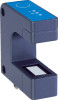
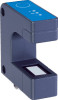
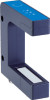
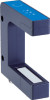
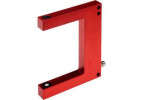
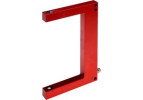
IPF fork ultrasonic sensors have the emitter and receiver in a common housing. Choose the UG800170 and UGKB0170 models according to the fork width, material dimensions and mounting space.
The common fork housing holds the emitter and receiver opposite each other. The detected object or material passes through the open gap and affects the sound beam. During installation, the main concerns are therefore the passage of the target, the required insertion depth and the fixing of the entire sensor.
IPF fork version; verify specific dimensions according to the order code.
UGKB0170: fork version with a gap width of 114 mm.
The fork width indicates the mechanical gap between the arms. For mounting, also compare the overall dimensions of the housing and the position of the active surfaces. The gap width alone does not describe all the detection properties of the sensor.
What to consider when choosing and wiring
Measure the largest dimension of the passing target and add space for deflection or vibration. The sensor location must allow the material to pass without touching the arms. Also verify the required sensing frequency and the ability to reliably detect the smallest object.
For the IPF models offered, compare the supply, PNP output, NO function and M8 connector according to the specific documentation. Choose the connecting cable according to the number of pins, wiring and operating environment.
Is a fork sensor automatically a label sensor?
The fork describes the housing design. To distinguish a label from the carrier web, choose a sensor intended for this task and verify the actual material.
How to choose between a fork gap of 74 and 114 mm?
Compare the largest dimension of the passing material, its deflection and the mounting space. UG800170 has a gap of 74 mm and UGKB0170 114 mm; also verify the insertion depth and the overall drawing of the housing.
Do two separate heads need to be adjusted during mounting?
The fork housing holds the emitter and receiver in a fixed relative position. During installation, you set the position of the whole sensor relative to the material path and check free passage without contact with the arms.
Selection and technical consultation
For selection or replacement, send the complete order code and a description of the application. TECHNOLINE technical support will help compare the required version.
We need technical cookies for the cart and checkout to work — these are always used. Analytics cookies show us which pages people look for and where they get lost, and help us improve the shop. We only use them if you allow it. More in the data processing policy.
Cookie settings
Choose which cookies we may use. You can change your choice at any time.
Technical cookies
Always active
They keep the cart contents, your login and selected language, and protect forms from abuse. An order cannot be completed without them, so they are used even without consent.
Analytics cookies
Google Analytics shows us traffic and behaviour on the website in aggregated form. This tells us which pages are not working for people. We do not identify anyone from this data.