

LR18XBF05DLO-5MPUR, LANBAO, inductive sensor 2-wire, M18, Sn 5 mm, 2-wire, NO, cable 5 m PUR
- Our price excl. VAT
- 16,83 €
- incl. VAT 21 %
- 20,36 €
Description
LR18XBF05DLO-5MPUR – Two-wire inductive proximity sensor
LR18XBF05DLO-5MPUR from LANBAO is a two-wire inductive proximity sensor, size M18 designed for continuous industrial operation. It detects metal objects without contact and switches in series with the load, so it needs only two wires — supply and signal share the same pair.
Key features
- Sensing distance 5 mm – rated value for a standard steel target.
- Output 2-wire, NO contact – normally open – connects to a PLC digital input or a relay coil.
- Supply 10–30 V DC.
- Flush mounting.
- Connection: cable 5 m PUR.
- Degree of protection IP67 – protection against dust and temporary immersion.
How an inductive sensor works
The coil in the sensing face generates a high-frequency magnetic field. When a metal object enters the field, it induces eddy currentsin its surface, which draw energy from the field and dampen it. As soon as the damping exceeds the set threshold, the evaluation circuit switches the output. All this happens without any contact, so the sensor has no mechanically wearing parts.
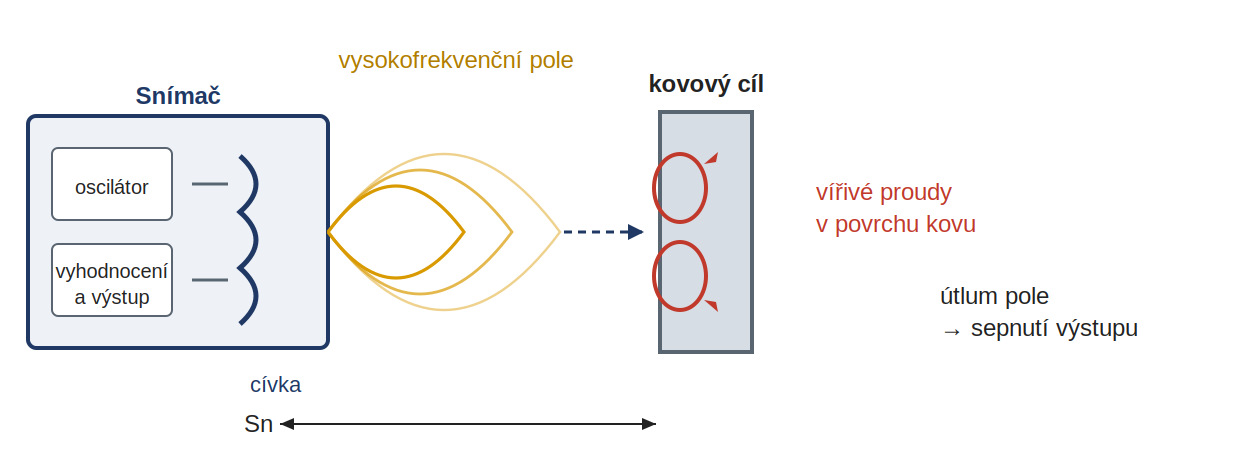
High-frequency oscillation principle: coil field, eddy currents in the metal target and their damping effect.
Correction factor – why the range on aluminium differs from steel
The rated sensing distance applies to a standard steel target. For other metals it is reduced by a correction factor. Calculate the actual distance as the rated Sn multiplied by the material factor.
| Steel St37 (standard target) | 1.0 |
|---|---|
| Cast iron | 0.93 – 1.05 |
| Aluminium | 0.60 – 1.00 |
| Stainless steel | 0.65 – 0.75 |
| Brass | 0.35 – 0.50 |
| Copper | 0.25 – 0.45 |
| Nickel | 0.25 – 0.45 |
Standard target and tolerance
According to the manufacturer's catalogue, the standard target is a square plate of St37 steel, 1 mm thick. The side length equals the larger of: the diameter of the sensing face, or three times the sensing distance. A smaller target means a shorter range. The sensing distance tolerance is ±10 %, so never set the working point exactly at the Sn limit.
Technical specifications LR18XBF05DLO-5MPUR
| Order code | LR18XBF05DLO-5MPUR |
|---|---|
| Manufacturer | LANBAO |
| Size / housing | M18 |
| Sensing distance (Sn) | 5 mm |
| Mounting / face design | flush |
| Output type | 2-wire |
| Contact function | NO – normally open |
| Supply voltage | 10–30 V DC |
| Connection | cable 5 m PUR |
| Degree of protection | IP67 |
| Status indication | LED |
| HS code (TARIC) | 85365019 |
| Country of origin | CN |
Wiring of LR18XBF05DLO-5MPUR by wire colours
| Wire | Colour | Wiring |
|---|---|---|
| 1 | brown (BN) | + supply (10–30 V DC) via the load connected in series |
| 2 | blue (BU) | − supply (M / 0 V) |
A two-wire sensor has no separate signal wire – the load (PLC input, relay coil) is connected in series with the sensor. Before use, compare the residual current and voltage drop of the sensor with the minimum values of the input you are connecting it to.
The colour coding complies with IEC 60947-5-2. Always compare the actual pin and wire assignment with the diagram in the sensor datasheet (Downloads tab).
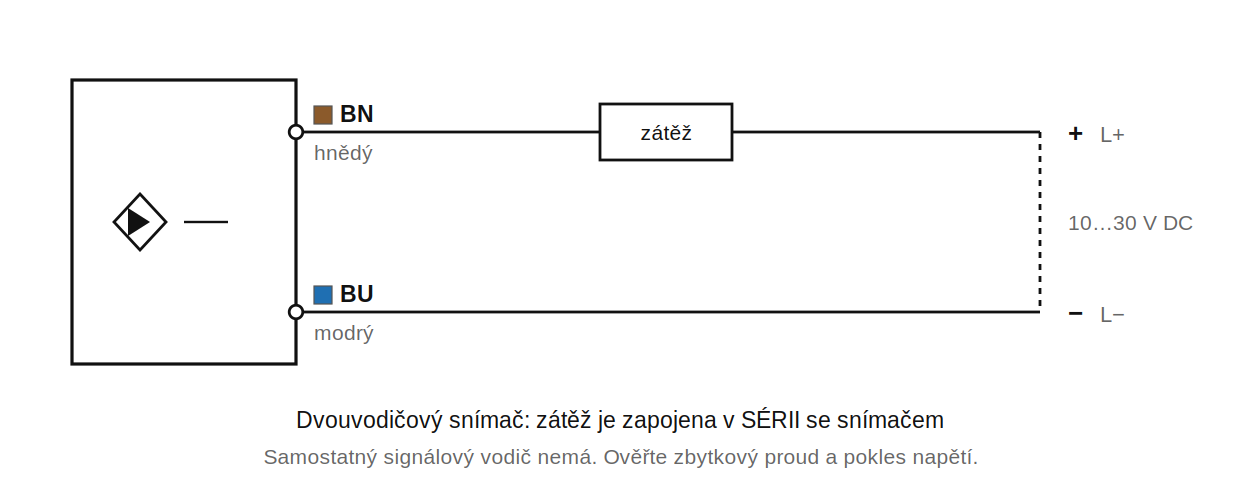
Two-wire connection – the load is in series with the sensor.
Mounting and free space
The sensor has a flush sensing face, so it can be screwed into a metal structure right up to the face without affecting its function. The trade-off is a shorter sensing distance compared to the non-flush version.
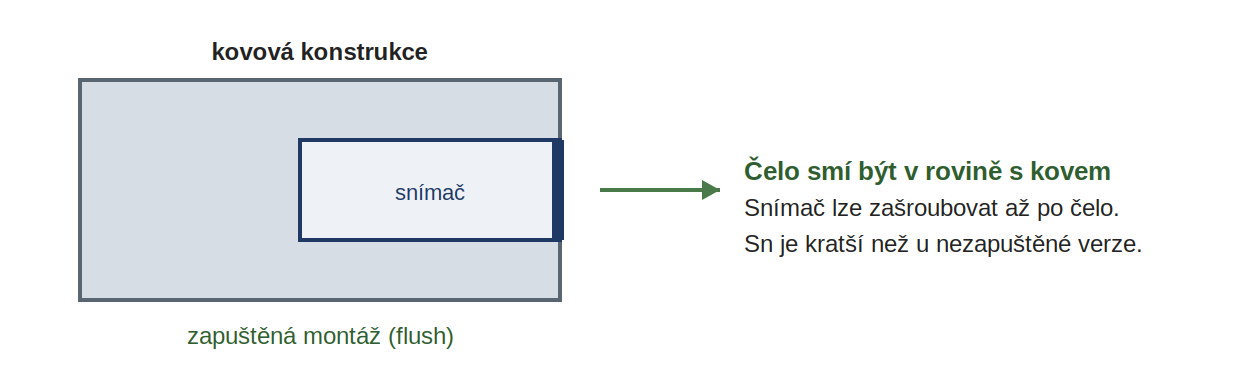
Flush mounting: the face may be level with the metal.
Mutual interference of sensors
Two sensors mounted close to each other may interfere with each other. If you need to sense at two adjacent points, keep the lateral spacing given in the sensor's dimension drawing, or offset the sensors so that their faces do not point into the same space.
Set the working distance to 70 to 80 % of the rated Sn, i.e. safely below 5 mm for this model. The tolerance is ±10 % and the distance also changes with temperature and supply voltage.
Typical applications
- retrofitting existing installations where only a two-core cable is laid
- replacing a mechanical limit switch without re-pulling the cabling
- saving wires and terminals in the control cabinet on large machines
- series connection with a relay, contactor or PLC input
- simple signalling and monitoring circuits
How to choose and what to watch out for
- Flush mounting: the sensor can be screwed into a metal structure right up to the face without affecting its function. Compared to the non-flush variant, however, it has a shorter sensing distance.
- Two-wire connection: the sensor is connected in series with the load. Before use, check the residual current and voltage drop against the minimum values of the input you are connecting the sensor to.
- NO contact (normally open): the output is activated when an object is detected. If you need the opposite logic, an NC variant is available.
- Cable outlet: the cheaper variant, but replacing the sensor requires pulling the entire cable. If you need quick replacement, choose a model with a connector (suffix -E1 for M8, -E2 for M12).
- Degree of protection IP67: protection against dust and temporary immersion. Not designed for permanent immersion or high-pressure washing – this requires IP69K.
- Sensing distance 5 mm is the rated value for a standard steel target. For stainless steel, brass, aluminium or copper it is reduced by a reduction factor – if you detect non-ferrous metals, allow a margin or choose a model with correction factor 1.
NO or NC – and why it is not just a matter of convenience
NO (normally open) is an output that is active on detection. NC (normally closed) is active at rest and opens on detection. The difference is a safety one: with NC, a broken wire causes the same reaction as a detection, so the fault shows up immediately. With NO, a broken cable remains unnoticed until someone tries to switch.
This model has the contact NO – normally open.
Similar models in the same series
Frequently asked questions
Does LR18XBF05DLO-5MPUR have a PNP or NPN output?
LR18XBF05DLO-5MPUR has a 2-wire output with an NO contact – normally open. Check that your PLC input matches this output type.
What is the sensing distance of LR18XBF05DLO-5MPUR?
The sensing distance (Sn) is 5 mm. This is the rated value for a standard steel target; the range is shorter for non-ferrous metals.
How is LR18XBF05DLO-5MPUR connected?
LR18XBF05DLO-5MPUR is supplied with the connection: cable 5 m PUR. The cable is part of the sensor; the other end is free for connection to a terminal block.
How is the two-wire sensor LR18XBF05DLO-5MPUR connected?
Brown wire to plus, blue to minus, and the load is connected in series with the sensor – the two-wire version has no separate signal wire.
What is the difference compared to a three-wire PNP/NPN sensor?
A two-wire sensor is connected in series with the load and does not need a separate signal wire. It saves one core in the cable, but a residual current flows through it and it has a higher voltage drop, which must be taken into account with sensitive PLC inputs.
A detailed datasheet with a dimension drawing and wiring diagram can be found in the tab Downloads.
We supply LR18XBF05DLO-5MPUR from the Czech Republic with an invoice and technical support. Not sure which one to choose? Send us your application parameters and we will recommend a suitable model.
Do you have a sensor from another manufacturer on your machine – SICK, IFM, Balluff, Omron or Pepperl+Fuchs? Send us its order code and we will cross-reference it to the matching LANBAO model.
Technical parameters
| Objednací kód | LR18XBF05DLO-5MPUR |
|---|---|
| Výrobce | Lanbao |
Ask about this product
Related products
 LR18XBF05DLO-E2, LANBAO, inductive sensor 2-wire, M18, Sn 5 mm, 2-wire, NO, connector M12/4 pins
LR18XBF05DLO-E2
12,92 €
excl. VAT · 15,64 € incl. VAT
 LR18XBF05DLC, LANBAO, inductive sensor 2-wire, M18, Sn 5 mm, 2-wire, NC, cable 2 m
LR18XBF05DLC
12,92 €
excl. VAT · 15,64 € incl. VAT
 LR18XBF05DLC-E2, LANBAO, inductive sensor 2-wire, M18, Sn 5 mm, 2-wire, NC, connector M12/4 pins
LR18XBF05DLC-E2
12,92 €
excl. VAT · 15,63 € incl. VAT
 LR18XBF05DLO, LANBAO, inductive sensor 2-wire, M18, Sn 5 mm, 2-wire, NO, cable 2 m PVC
LR18XBF05DLO
12,93 €
excl. VAT · 15,64 € incl. VAT