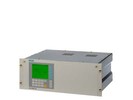
CALOMAT 6E — Thermal Conductivity Analyser
CALOMAT 6E helps monitor gas composition where a change in thermal conductivity can be reliably assigned to the target component. When specifying, it is therefore not enough to state "hydrogen measurement". It is equally important to name the rest of the mixture and describe what happens to it during production, shutdown and switching of raw materials. The public range in this category includes, for example, order codes 7MB2521-1AA00-1AA1 and 7MB2521-0CB00-1AA1; their application settings must be assessed individually.
Physical principle and the significance of the gas background
CALOMAT 6 keeps thin-film resistors on a silicon chip at a constant temperature. The required heating current depends on the thermal conductivity of the surrounding mixture; the concentration signal is derived from it. Details are explained in the Siemens CALOMAT 6 manual. This is not chemically selective detection of hydrogen alone.
A change in the proportion of helium, carbon dioxide or water vapour can change the result even though the target component remained the same. The relationship between thermal conductivity and concentration may also not be linear. To design a correction, you need to know the interfering components and their variability. One calibration mixture cannot prove behaviour under all independent changes of the gas background.
How to prepare the specification and sample
In the enquiry, write the normal composition and, separately, the limit operating states. For each admixture, distinguish a constant proportion from a fluctuating one. Also propose how it will be demonstrated during acceptance that a change in background does not cause an unacceptable deviation. If the correction is to use another analyser, require a joint test of both measuring paths including the time course. The aim is not only to obtain the correct number in a steady state, but also to correctly evaluate the transition between two recipes. Assign the intended operating state to each test mixture; this will reveal whether the acceptance plan omits an entire production recipe.
The sample must be dust-free and must not condense. Siemens CALOMAT 6, manual, chapter 2.3 states conditioning by sampling, cooling and filtration according to the task. For rack installation, reserve access to the gas connections, service space and room for sample discharge.
Author's example: change of concentration basis
Imagine an ideal mixture containing 4.00 volume part of hydrogen, 8.00 part of water vapour and 88.00 part of other gases. On a wet basis, the proportion of hydrogen is 4.00 %. If, in a thought calculation, we remove all water and keep the other components, 92.00 part of gas remains. The dry proportion of hydrogen is then 4.00 / 92.00 × 100 = 4.35 %.
The difference of approximately 0.35 percentage point arose from a change in the denominator. It is not an error of the device or the CALOMAT specification. The model neglects residual moisture and any losses of components during conditioning. At the same time, it does not calculate the direct influence of water on thermal conductivity. When comparing a laboratory result with a process measurement, first unify the concentration basis and the sampling point; only then assess the deviation.
Commissioning and common mistakes
Prepare a record that links the calibration mixture used, the device settings and the actual operating sample. Pay particular attention to the return after calibration: do not consider only the moment when the expected value appears on the display as an acceptable result. Also determine the stabilisation time and repeatability after switching again. A common mistake is to adjust the calibration according to one unusual sample without verifying whether the background composition has changed in the meantime.
FAQ
Can the same device be used for any mixture?
Such a conclusion does not follow from the series designation. Describe the new application with the complete composition and have the measuring task, materials and configuration of the specific order number confirmed.
When to compare another measuring principle?
If the target is trace oxygen, examine OXYMAT 64. An overview of other principles is offered by the category Siemens gas analysers. Decide according to the target component and matrix, not just the number of displayed decimal places.